Best Budget Binoculars for Bird Watching: Top Picks Under $100
21 June 2026 · Diego Monzón
Agréganos como fuente preferida en Google
Watching a resplendent quetzal vanish into the cloud forest above Lake Atitlán, or spotting a belted kingfisher dive from a dockside branch in Panajachel — these are the moments that turn a Guatemala trip into something unforgettable. But you don't need to spend a fortune to bring those birds in close. The best budget binoculars for bird watching have improved dramatically in recent years, and today you can get genuinely capable optics for under $100. Whether you're packing light for a weekend on the shores of Lake Atitlán or building your first serious birding kit, this guide covers the top picks, what to look for, and exactly how to match a pair to your needs.
Why Budget Binoculars Are Better Than Ever
Five years ago, "budget binoculars" was essentially a synonym for blurry, dim, and frustrating. That has changed. Manufacturers like Celestron, Bushnell, and Nikon have pushed quality optics down the price ladder, partly driven by competition and partly by improvements in low-cost lens coatings. The result: you can now buy a pair with fully multi-coated lenses, waterproof sealing, and a close focus distance under 6 feet — all for less than a good restaurant dinner in Antigua. The trade-offs versus $400 optics are real (lower-light performance, color fringing at the edges, slightly softer images in poor conditions), but for daytime birding in bright tropical light, the gap has shrunk considerably.
Buying Guide: What to Look For Under $100
Before diving into specific models, here's what the numbers actually mean — and which specs matter most when you're watching birds on a budget.
Magnification and objective lens (e.g., 8x42): The first number is magnification; the second is the diameter of the front lens in millimeters. For bird watching, 8x42 is the gold-standard configuration at any price point. The 42mm objective gathers enough light for good daytime performance, and 8x magnification gives you a wide enough field of view to track moving birds without losing them. A 10x42 brings birds closer but amplifies hand shake — a real problem with budget optics that lack image stabilization.
Lens coatings: This is where cheap binoculars fail hardest. Look for "fully multi-coated" lenses, which apply anti-reflection coating to every glass surface. "Coated" or "multi-coated" (without "fully") means only some surfaces are treated — acceptable, but you'll notice the difference in low light or when pointing toward bright sky.
Waterproofing: If you're birding anywhere near water — and at Lake Atitlán you will be — waterproofing is not optional. Look for "O-ring sealed" and ideally "nitrogen-purged" (which prevents internal fogging). Several sub-$100 binoculars now offer genuine waterproofing, not just water resistance.
Close focus distance: Many tropical birds (hummingbirds, motmots, trogons) appear unexpectedly close. A close focus distance under 8 feet lets you watch without backing away.
Eye relief: Glasses wearers need at least 14mm of eye relief to see the full field of view. Check this spec before buying if you wear glasses.
Top Budget Binoculars for Bird Watching Under $100
Celestron Nature DX 8x42 (~$80–90) — Best Overall: This is the binocular I recommend first to anyone starting out. The Nature DX punches well above its price with fully multi-coated lenses, nitrogen purging, and O-ring waterproofing — features you normally pay $150+ to get. Image sharpness is excellent in the center of the field, and the close focus distance of around 6.5 feet is genuinely useful for hummingbird watching. The rubber armor is comfortable and grippy even in humid conditions. If I were heading to Atitlán for the first time and wanted one pair of binoculars under $100, this would be it.
Bushnell H2O 8x42 (~$70–80) — Best for Wet Conditions: The H2O line is Bushnell's dedicated waterproof series, and it shows. The rubber armor is among the most durable in this price range, the grip is excellent even with wet hands, and the optics deliver solid images in good light. It's not quite as optically refined as the Celestron Nature DX, but for anyone kayaking on the lake or birding in the rain around Tzununá or Santa Cruz La Laguna, the rugged build is worth the slight optical trade-off.
Nikon Aculon A211 8x42 (~$60–70) — Best Brand Name Entry: Nikon's Aculon series uses their "Eco-Glass" lenses (lead and arsenic free) with multi-coated optics at an accessible price. The image quality is good, and the Nikon name carries real quality control behind it. Not waterproofed, which limits its appeal for serious field use, but for casual birding on dry days or travel where you want a compact name-brand pair, the Aculon A211 is a solid value.
Gosky 10x42 Roof Prism (~$50–60) — Best for Distance Birding: If your priority is watching birds on distant volcanic slopes — say, scanning the flanks of Volcán Tolimán for raptors — the extra reach of 10x magnification is tempting. The Gosky 10x42 delivers surprisingly good sharpness at this price point, with a BAK-4 prism (the better glass type) and fully multi-coated lenses. Hand shake at 10x is a real limitation, so brace your elbows or use a monopod when scanning. Not waterproofed.
Vortex Crossfire HD 8x42 (~$99–120 street price) — Stretch Pick: Technically just above the $100 mark depending on where you find it, but worth mentioning because Vortex's lifetime warranty is genuinely unlimited and no-questions-asked — a compelling argument when you're buying entry-level gear. The Crossfire HD uses HD glass for noticeably better color accuracy than most competitors under $120. If you can find it on sale at $99, buy it immediately.
Birding at Lake Atitlán: What You'll Actually See
Lake Atitlán sits at 1,562 meters elevation and is surrounded by cloud forest, coffee fincas, reed beds, and volcanic slopes — a combination that produces exceptional bird diversity. The lake itself hosts rufous-naped wrens, Atitlán grebe (now sadly extinct, but other waterbirds abound), great blue herons, and both ringed and Amazon kingfishers. The surrounding forest adds collared trogons, resplendent quetzals at higher elevations, and dozens of hummingbird species including the wine-throated hummingbird and the magnificent hummingbird.
For most of these birds in most conditions, a budget 8x42 binocular works perfectly well. Hummingbirds visit flowers close to trails; herons stand patiently on lakeside rocks; kingfishers perch on visible branches. Where budget optics start to struggle is dawn and dusk (when many species are most active) and when scanning distant forest canopy in shadow. If you plan serious dawn birding on the cloud forest trails above San Pedro or Santiago, you'll feel the limitations of a $70 binocular. But for a typical day of casual birdwatching around the villages and lake shores, the budget options listed here are absolutely sufficient.
Care and Maintenance Tips
Budget binoculars last surprisingly long with basic care. Keep them dry even if they're waterproof — waterproofing protects against splashes, not submersion. Use the neck strap religiously; drops are the primary cause of optical misalignment. Store in the case, not loose in a bag where lens caps fall off. When cleaning lenses, blow off dust first with a blower brush, then use a microfiber cloth in gentle circular motions — never use your shirt fabric, which carries grit that scratches coatings. With this level of care, a Celestron or Bushnell binocular in this price range should give you five to ten years of reliable use.
Our Recommendation
For first-time birders visiting Lake Atitlán, the Celestron Nature DX 8x42 is the clear choice: fully multi-coated, waterproof, and optically sharp enough to make every hummingbird encounter memorable. If your budget runs closer to $60 and you're birding in dry conditions, the Nikon Aculon A211 offers reliable optics with strong brand backing. Either way, you'll be equipped to get the most out of one of Central America's finest birding destinations.
Best Budget Binoculars Under $100 for Birdwatching
You don't need to spend $500 to enjoy birdwatching at Lake Atitlan. These budget binoculars under $100 deliver surprisingly good optics for beginners and casual birders:

Celestron – Nature DX ED 8x42 Premium Binoculars – Extra-Low Dispersion Objective Lenses – Outdoor and Birding Binocular
$199.99
Check Price on Amazon →
Bushnell H2O 8x42mm Binoculars, Waterproof and Fogproof Binoculars for Boating, Hiking, and Camping
$89.00
Check Price on Amazon →
Nikon ACULON A211 12x50 Binocular | Multilayer coating, Porro prism Binocular with turn and slide eyecups, Tripod Adaptable
$129.99
Check Price on Amazon →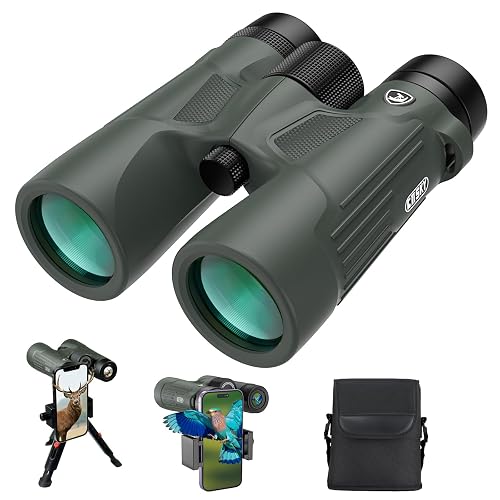
Gosky 10X42 HD Binoculars for Adults with Phone Adapter, High Power Binoculars with BAK4 Prism and FMC Lens, Waterproof
$72.99
Check Price on Amazon →
Occer 12x25 Compact Binoculars for Adults and Kids, Large Eyepiece Waterproof Binocular with Low Light Vision, High Powered
$35.98
Check Price on Amazon →Frequently Asked Questions
What are the best binoculars under $100 for beginners?
The Celestron Nature DX 8x42 ($80-90) is the best budget birdwatching binocular under $100. It has fully multi-coated lenses (unusual at this price), is waterproof, and delivers crisp images in good light. The Bushnell H2O 8x42 is a close runner-up with rugged rubber armor and excellent waterproofing for the price.
Can budget binoculars work for birdwatching at Lake Atitlan?
Yes, for most birding at Lake Atitlan. The lake's star birds — hummingbirds, kingfishers, herons — are often close enough that even $50 binoculars work well. Budget binoculars struggle in dim light (cloud forest, dawn/dusk) and at long distances. If you want to spot birds on distant volcanic slopes, consider stepping up to mid-range ($150-300).
8x vs 10x magnification for budget binoculars?
8x is better for beginners: wider field of view makes it easier to track moving birds, and hand-shake is less noticeable at 8x than 10x (important for budget optics without image stabilization). 10x is better for distant birds but requires steadier hands. Go with 8x42 for Lake Atitlan birdwatching.
How long do budget binoculars last?
With basic care (keeping them dry, using the strap, storing in the case), budget binoculars from Celestron, Bushnell or Nikon last 5-10 years. The main failure points are lens coating wear (from cleaning too aggressively) and hinge loosening. Avoid wiping lenses with shirt fabric — always use a microfiber cloth.
This article contains affiliate links. As an Amazon Associate, we earn from qualifying purchases at no extra cost to you.