Basic Kaqchikel and Tz'utujil Phrases for Your Atitlán Trip
16 July 2026 · Diego Monzón
Add us as a preferred source on Google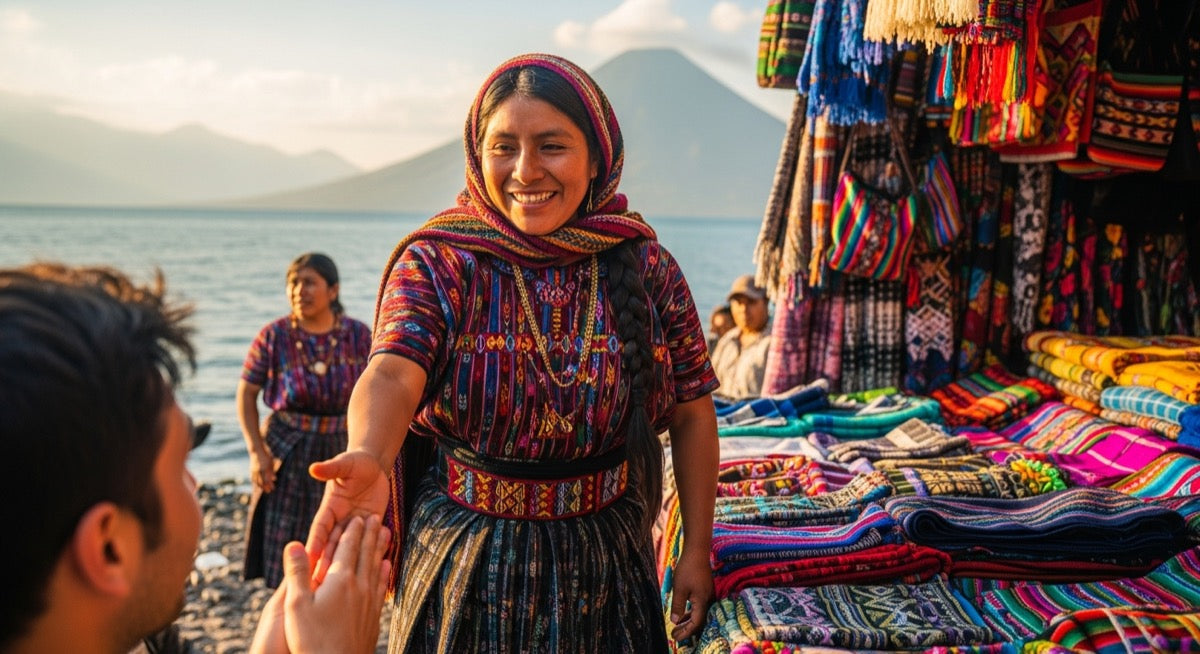
Arriving at Lake Atitlán and greeting people in the local language is one of the most beautiful ways to connect with the Maya towns that surround its waters. Although Spanish is spoken in every town, a few words in Kaqchikel or Tz'utujil open doors, spark smiles and show respect for a culture that has thrived for centuries. In this guide you'll find the most useful phrases for your trip, with an honest note: spelling and pronunciation can vary from one community to another.
How do you say “good morning” in Kaqchikel and Tz'utujil?
In Kaqchikel, a widely documented way to say good morning is “Saqarík”. In Tz'utujil you say “Saqar q'ij” (respectful approximations). Both relate to the dawn and the new day. And the word most worth memorizing is “Matyox”: it means thank you in both Kaqchikel and Tz'utujil, and it's the one that will earn you the most smiles in markets, boats and eateries.
Table of basic phrases (Spanish · Kaqchikel · Tz'utujil)
These are the essential phrases for your daily life around the lake. The forms for good morning and thank you are widely documented; the rest are useful approximations that may vary by community.
| Spanish | Kaqchikel | Tz'utujil |
|---|---|---|
| Hello / Good morning | Saqarík | Saqar q'ij |
| Thank you | Matyox | Matyox |
| Yes | Ja' (approx.) | Ja' (approx.) |
| No | Manäq (approx.) | Ma (approx.) |
| How much is it? | ¿Janipe' rajil? (approx.) | ¿Janipe' rajil? (approx.) |
| Goodbye / See you later | Ka chi qawäch (approx.) | Ka chi qawäch (approx.) |
Cultural note: living Maya languages
Kaqchikel and Tz'utujil are not languages of the past: they are living Maya languages spoken every day in the homes, schools and markets of Lake Atitlán. Together with K'iche', they are part of the rich identity of the department of Sololá, in Guatemala's western highlands. Trying a few words, even with an accent, is almost always met with warmth and a smile. Don't be afraid to make mistakes: the effort itself already conveys respect.
The dominant language changes from town to town. San Pedro La Laguna and Santiago Atitlán are Tz'utujil, while Panajachel, San Antonio Palopó and Santa Catarina Palopó are Kaqchikel. If you visit San Juan La Laguna, a Tz'utujil town, you'll hear this language in its weaving cooperatives and single-origin coffee shops.
Tips for using these phrases respectfully
Learning an Indigenous language is a privilege, not a tourist trick. Keep these simple recommendations in mind so your effort is well received:
- Spelling varies. Kaqchikel and Tz'utujil are written with standardized Maya alphabets, but the exact form may differ between communities. If someone corrects you, thank them: it's the best way to learn.
- Start with “Matyox.” If you only memorize one word, make it thank you. It's useful, universal in the region and always appropriate.
- Ask and listen. Locals are the best source. Asking someone to teach you how to say something often sparks memorable conversations.
- Don't force it. Use the phrases naturally; if you can't remember them, Spanish works perfectly in every town.
Frequently asked questions
How do you say good morning in Kaqchikel?
In Kaqchikel, a widely documented way to say good morning is “Saqarík.” In Tz'utujil, people say “Saqar q'ij.” These are morning greetings that evoke the dawn of the day.
How do you say thank you in Kaqchikel?
Thank you is “Matyox” in Kaqchikel, and also “Matyox” in Tz'utujil. It's one of the most useful and appreciated words: using it in the markets and boats of the lake usually earns you a smile.
What language is spoken at Lake Atitlán?
Around Lake Atitlán, three living Maya languages are spoken: Kaqchikel, Tz'utujil and K'iche', in addition to Spanish. The dominant language varies by town: San Pedro and Santiago Atitlán are Tz'utujil, while Panajachel and San Antonio Palopó are Kaqchikel.
What is the difference between Kaqchikel and Tz'utujil?
Both are related and quite close Maya languages, so they share many words (such as “matyox,” thank you). They are spoken in different areas of the lake and have differences in pronunciation and vocabulary. Written spelling can also vary by community.
Is Spanish spoken at Lake Atitlán?
Yes. Spanish is widely spoken throughout the region and you'll be able to communicate easily in hotels, restaurants, shops and transport. Even so, learning a few phrases in Kaqchikel or Tz'utujil is a gesture of respect that locals greatly value.