Best Folding Camping Chair for Camping in Guatemala
20 July 2026 · Diego Monzón
Add us as a preferred source on Google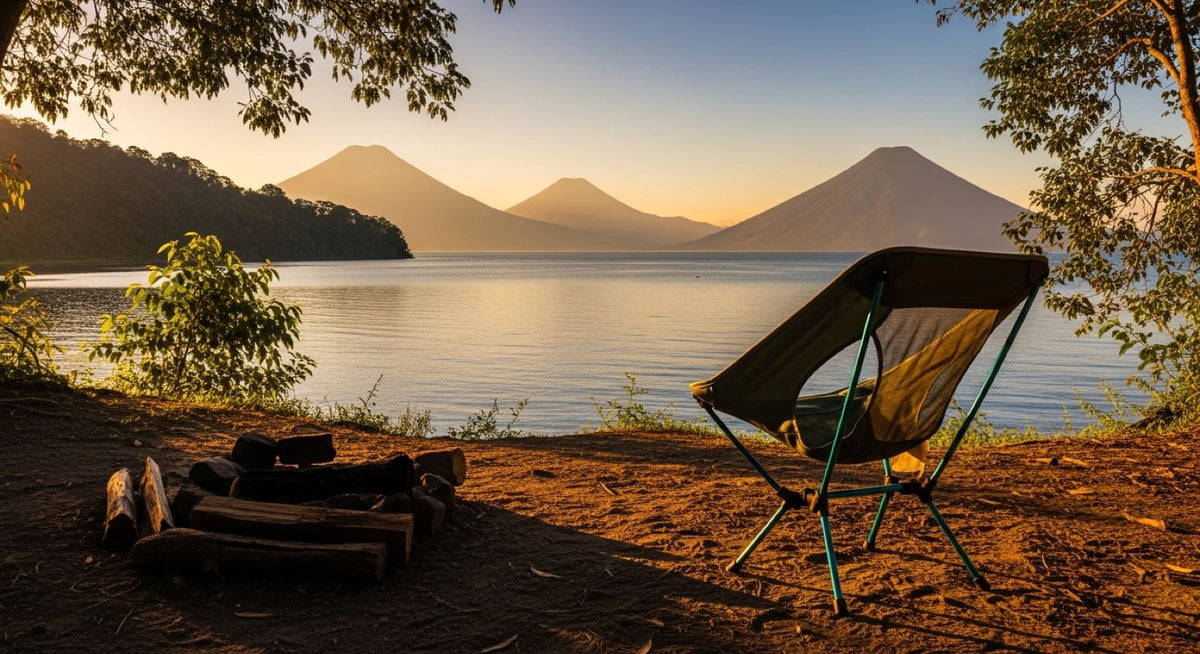
As an Amazon Associate, I earn from qualifying purchases. After several seasons setting up camp on the shore of Lake Atitlán — in Sololá, at roughly 1,562 meters above sea level — we learned something no spec sheet tells you: the camp chair is the piece of gear you enjoy most and choose worst. People shop carefully for the tent and the sleeping bag, then grab a chair at the last minute. Then they spend four hours watching the sun drop behind San Pedro Volcano while sitting on a cold rock.
This guide reviews five folding camping chairs that actually work in Guatemalan conditions: dark volcanic sand beaches, damp grass at the lookouts, temperatures between 15 and 25 °C, and that afternoon wind we call the Xocomil, which starts blowing across the lake almost on schedule. None of them is perfect for everything. That's why the criterion behind this selection isn't "which is the best chair," but which is the best chair for how you get to camp.
Before you buy: the three types of chair and which one is yours
Almost every folding chair on the market falls into one of three families, and mixing them up is the most expensive mistake you can make.
1. The low chair. The seat sits 25-35 cm off the ground, the frame is aluminum poles that clip together like tent poles, and the whole thing weighs between 0.9 and 1.5 kg. This is the backpacker's chair. It packs down to the size of a large water bottle. In exchange, sitting down and standing up takes more effort — worth noting if you're traveling with older adults — and the backrest reaches mid-back, not the back of your head.
2. The high-back chair. Seat at 40-50 cm, backrest all the way up to your head, almost always with a cup holder and side pocket. It weighs between 2.5 and 4 kg. This is the chair for camps you reach by car or by boat with cargo: Panajachel, Santa Cruz, any site with vehicle access. If you plan to spend the night talking around the fire, this is the one you'll be grateful for.
3. The ultralight stool. No backrest, three or four legs, 0.5-1 kg. It isn't comfortable for three hours straight, but it weighs about as much as a T-shirt and solves the problem of sitting down at a lookout or while you cook.
On top of that, three numbers genuinely matter and most people ignore them:
- Weight capacity. Look for 110 kg minimum. Chairs rated under 100 kg fail at the seat seams first, not at the poles.
- Foot width on the legs. This is the Atitlán factor. A thin tube leg sinks into the volcanic sand at the San Marcos or Tzununá beaches and into soft grass after rain. Chairs with wide feet, large plastic caps or ski-style bases float; thin-tipped legs bury themselves five centimeters deep and leave you sitting crooked.
- Packed volume. Not the weight — the volume. A 1.2 kg chair that folds to 35 x 12 cm slides vertically into a 50-liter pack. A 3 kg chair that folds to 90 cm long only travels by car or strapped to the outside, and on a public boat that gets in everyone's way.
A practical rule we use: if you're going to walk more than 30 minutes with everything on your back, your chair shouldn't exceed 1.5 kg. If the car reaches camp, forget about weight and buy comfort. If you're still deciding where to go, first check out the best places to camp, because how you access the site determines the chair more than anything else.
1. Wind Tour silla de camping portátil ligera plegable

This is the classic take on the backpacker low chair: an aluminum pole frame that assembles in under a minute, tough fabric and an included carry bag. It's the one we recommend to anyone arriving at the lake by public boat from Panajachel who still has a twenty- or thirty-minute walk to the shore with a loaded pack.
Who it's for: backpackers, travelers moving by shuttle and boat, anyone who packs light. The good: packed volume is its strongest argument — it goes inside the pack, not dangling off the outside, which on a boat is the difference between a comfortable ride and an awkward one. The shock-corded poles don't tangle in cold weather or with wet hands. The honest part: the backrest doesn't support your head, so after two hours you'll want something to lean against. And like every low chair, it puts you close to the ground: on wet grass after a rainy-season downpour (May to October) you'll feel the damp much closer. Our suggestion is to carry a small 1 x 1 m tarp to put underneath.
2. Wildhiker sillas de camping plegables con respaldo alto

If your campsite has car access, this is the category to look at. The high backrest completely changes the evening: you can tip your head back and stare at the sky, which over the lake — far from city lights — is the main reason many people camp here in the first place.
Who it's for: families, couples, two- or three-night base camps, anyone driving their own vehicle to Panajachel or Santiago Atitlán. The good: the full backrest and normal seat height mean standing up isn't a core workout, something parents and grandparents appreciate equally. Coming as a pair, it outfits a two-person camp in a single purchase. The honest part: it's heavy and bulky. Folded, it's still a long package that won't fit in a pack and that takes up another passenger's space on a public boat. This isn't a chair for hiking; it's a chair for staying put.
3. Taburete plegable tipo mochila 2 en 1 para acampar

The most underrated category. A stool doesn't compete with a chair: it competes with bringing nothing at all. And it wins that comparison every time. This model adds the detail that makes it genuinely useful in Guatemala: it doubles as a carry bag, so your seat and your gear are the same piece of kit.
Who it's for: hikes to the lookouts, partial volcano climbs — Atitlán reaches 3,537 m, Tolimán 3,158 and San Pedro 3,020 — fishing, sunrise photography, and anyone who cooks standing up at camp and only needs to sit for five minutes. The good: the weight and volume are almost imperceptible in a pack, and the dual use justifies bringing it even when you're not sure you'll need it. The honest part: with no backrest, your back will complain after forty minutes. And the low height makes it awkward for eating at a table. It's a complement, not the main chair at camp.
4. Picnic Time silla portátil plegable de deportes

The "stadium chair" format with a shoulder strap is the most versatile of the group, because it doesn't live at camp exclusively. The same chair you use by the fire works for the game, the lakefront in Panajachel, or waiting for the boat at the dock.
Who it's for: people who camp two or three times a year and don't want gear that sits in storage the rest of the time. The good: the shoulder strap changes the real-world logistics a lot — both hands stay free for the cooler and the pack, which is exactly what you need heading down the steps of a boat landing. It's a brand with a long track record in this kind of product, and the finish shows it. The honest part: this is a firm-ground chair. On loose volcanic sand or wet soil the legs sink more than a wide-footed chair would, so if you're camping on a beach, slip a thin board or a flat stone under each rear leg. It also isn't the lightest option for walking.
5. Paquete de 4 sillas plegables de camping ligeras y portátiles

When you're camping as a group, buying four separate chairs rarely makes sense. This pack solves the host's problem: the person who brings the car, the big tent, and ends up lending gear to everyone.
Who it's for: large families, groups of friends, people who organize recurring camping trips or rent gear to visitors. The good: uniformity helps more than you'd think — four identical chairs stack the same way, take up a predictable block in the trunk, and nobody argues about who gets "the good one." Being lightweight models, they're still easy to move from the car to the site. The honest part: multipacks usually have lower weight capacity and less padding than a single high-end chair. For occasional use they work without drama; if you camp every other weekend and are close to the stated limit, one sturdy chair beats four average ones.
Quick comparison
| Chair | Type | Fits in a backpack? | Best for |
|---|---|---|---|
| Wind Tour ligera plegable | Low chair | Yes | Backpackers arriving by boat and walking in |
| Wildhiker respaldo alto | High-back chair | No | Base camp with car access |
| Taburete 2 en 1 tipo mochila | Ultralight stool | Yes, you barely notice it | Lookouts, hikes, cooking |
| Picnic Time portátil de deportes | Chair with shoulder strap | Carried over the shoulder | Mixed use: camp, beach and events |
| Paquete de 4 sillas ligeras | Group set | No, they travel by car | Families and large groups |
How a folding chair behaves at Atitlán
Three local details you won't find in a generic review. First, the Xocomil: that wind that rises over the lake in the afternoon moves empty, very light chairs around. If you leave your chair alone while you go for a swim, put your pack on it; more than one has ended up in the water. Second, the dark volcanic sand on several beaches absorbs heat during the day and is looser than sea sand: thin legs sink and a low chair loses stability. Third, the season: between November and April the ground is firm and almost any chair works; from May to October the terrain gives way after the daily rain, and that's when wide feet stop being a luxury.
A logistics note: the shuttle from Antigua takes about 3 hours and from Guatemala City around 3.5, and public boats between villages cost between Q10 and Q25. On a boat, a long bundle is in the way and sometimes you'll be charged extra for it. That's another reason backpackers should stick to the low chair or the stool. And once you've sorted out where you'll sit, there's still the roof over your head: choosing the right tent matters even more for the quality of your night.
Frequently asked questions
Which camping chair is best for camping in Guatemala?
It depends on how you reach the site. If you're walking in with a pack or traveling by public boat, a low chair under 1.5 kg is the answer. If you drive right up to camp, a high-back chair is far more comfortable for long evenings. For Guatemalan terrain — wet grass in the rainy season and volcanic sand on the lake beaches — prioritize wide-footed legs above any other feature.
How much should a portable camping chair weigh?
The practical benchmark is 1.5 kg. Below that number the chair is walkable without regret; above it, it starts competing with food and water in your pack. Chairs in the 2.5 to 4 kg range are perfectly valid, but only if a vehicle carries them to the site. Ultralight stools come in under 1 kg, and some hover around half a kilo.
High or low chair for camping?
The high chair wins on comfort: head-height backrest, normal seat height and easier to stand up from, which matters with small children or older adults. The low chair wins on transport and on stability in wind, because its center of gravity sits lower — relevant when the Xocomil picks up in the afternoon. If the car reaches camp, go high. If you have to carry it, go low.
Does a folding chair fit in a backpack?
Only the backpacking type. Low chairs with aluminum poles fold down to a package similar to a large bottle and slide vertically into a 50-liter pack, or strap to one side without unbalancing it. Ultralight stools even fit in a daypack. High-back chairs and multipacks don't fit: they fold into a long bundle you carry by hand or in the trunk.
Do folding chairs hold up on soft ground or sand?
They hold up if the leg ends in a wide foot or a large plastic cap; they sink if it ends in a thin tube. On volcanic sand or soaked grass, a thin leg can bury itself several centimeters and leave the chair tilted. The field fix is simple: put a thin board, a flat stone or even a rigid lid under each rear leg, which is where the weight concentrates when you lean back.
The bottom line
There is no single best folding camping chair for Guatemala; there's the one that matches how you arrive. The backpacker stepping off the boat in San Marcos with a twenty-minute walk ahead needs the lightweight low chair. The family parking next to the tent needs the high back. The person heading up to the lookout at sunrise needs the stool that weighs almost nothing. And whoever organizes the group trip needs the four-pack. Define how you'll get there first, check packed weight and leg width, and the choice becomes obvious. The payoff is concrete: being seated and comfortable when the sun drops behind the volcanoes and the lake turns orange.