Headlamps for Volcano Hikes: Which One to Bring to Guatemala
01 July 2026 · Shopify API
Add us as a preferred source on Google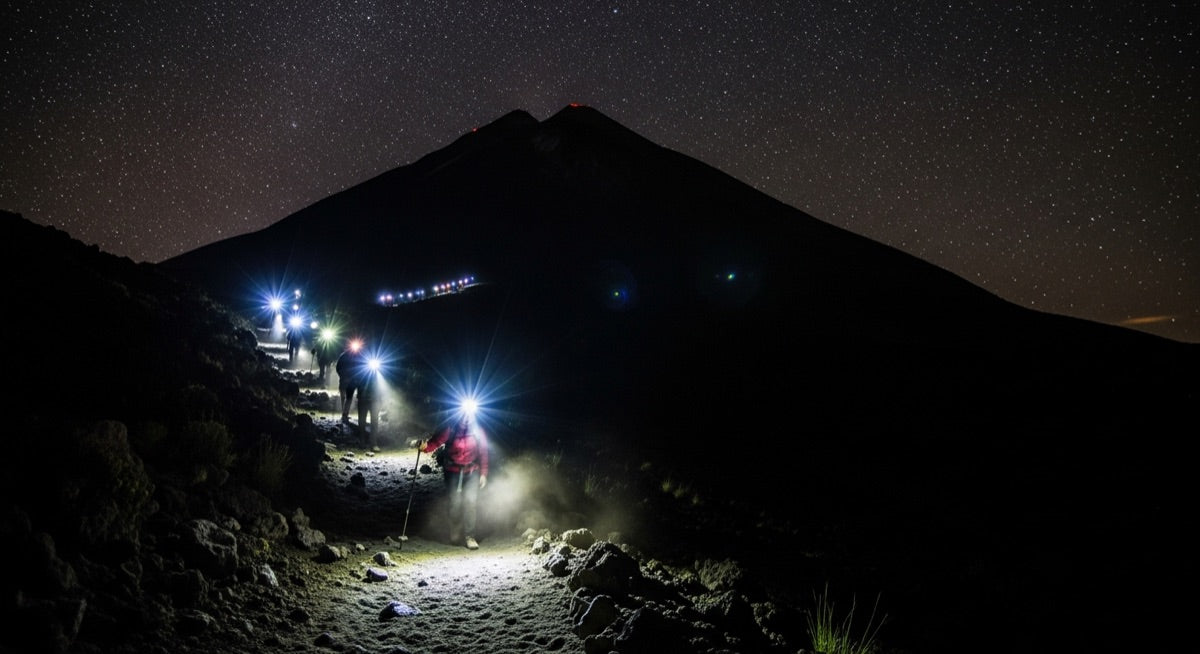
It's 3:45 in the morning in San Pedro La Laguna. The guide takes attendance, checks that everyone has water, warm layers… and a headlamp. Anyone without one doesn't get to climb, and for good reason: the first two or three hours of any volcano hike in Guatemala happen in total darkness, over roots, loose ash, and dirt steps that don't forgive a misstep. Choosing the right headlamp for volcano hikes isn't a gear afterthought: it's the difference between enjoying the climb and suffering through it. In this guide I'll walk you through exactly what to look for — real lumens, battery type, weight, red light, and summit-weather resistance — with specific recommendations tested on the sunrise climbs of San Pedro, Tolimán, and Acatenango.
Why a headlamp is mandatory gear on Guatemala's volcanoes
All the classic sunrise climbs start in the early hours. San Pedro volcano departs between 3:00 and 4:00 AM to reach the summit as the sun rises behind Lake Atitlan. Tolimán, less traveled and with a wilder trail, demands even more attention to your footing in the dark. And on Acatenango, Guatemala's crown jewel, the final push to the summit starts at 4:00 AM in sub-zero cold and wind.
In all three cases the pattern is the same: uneven volcanic terrain, crisscrossing roots, dust and ash shifting under your boots, and zero artificial light. Local guides require a headlamp — not a handheld flashlight, not your phone — because you need both hands free: to brace yourself on steep sections, grab branches, adjust trekking poles, or simply keep your balance. A handheld flashlight ties up a hand you're going to need; your phone, on top of that, runs out of battery right when you want to photograph the sunrise.
Lumens: how many you really need (spoiler: fewer than you think)
Headlamp marketing is a war of inflated numbers. For a volcano trail you need between 200 and 400 real lumens:
- 200 lumens: enough to walk single file behind the guide while clearly seeing where you step 3-4 meters ahead. That's the comfortable minimum.
- 300-400 lumens: the sweet spot. Margin for technical sections, fog in Tolimán's cloud forest, or finding the trail if the group gets separated.
- 500+ lumens: you'll almost never use high mode, and the cost is real: the battery dies in 2-3 hours right when you need it most.
Two mountaineer's warnings: first, be wary of generic headlamps advertising “1000 lumens” at bargain prices — the number is rarely real and the beam is usually a spot with no spread. Second, pay attention to the runtime on medium mode, which is what you'll use 90% of the time: look for at least 4-6 hours, which is how long the dark part of the climb plus the descent lasts if anything runs late.
USB rechargeable or batteries? It depends on where you're staying
This is the key dilemma when traveling around the lake. The local reality: in San Pedro, San Marcos, and Panajachel virtually every accommodation has electricity, but power outages are frequent, especially in the rainy season. Counting on “I'll charge it tonight” is risky.
USB-C rechargeable is the best option for most people: no money spent on batteries, it charges from the same power bank as your phone, and lithium batteries perform better in the cold. Golden rule: charge it the afternoon before, not the night before, in case the power goes out.
AAA batteries still make sense as a backup: you can find them in any corner store around the lake, and a spare set weighs nothing. Their weakness is the cold — alkalines lose noticeable performance on Acatenango's summit.
The winning option: hybrid models that run on their own rechargeable battery and accept AAA batteries in an emergency. That's what I recommend if you're chaining several volcanoes or camping. Whatever you choose, always carry a 10,000 mAh power bank: it covers your headlamp, phone, and camera.
Weight: the 100-gram rule
You'll be wearing the headlamp on your forehead for 3 to 5 hours. Anything over 100 grams including the battery starts to make itself felt: it bounces as you walk, presses on your forehead, and forces you to re-tighten the strap over and over. Modern trail models hover around 50-90 g and disappear completely. Details that matter: an adjustable strap that doesn't slip with sweat (reflective ones add safety in a group), a tilting head so you can aim at the ground without lowering your head, and buttons you can operate with gloves on — on Acatenango's summit you won't want to take your gloves off to switch modes.
Red light: the mode your group will thank you for
It sounds like a decorative extra, but it's one of the most important features on group climbs. Human night vision takes 20-30 minutes to adapt to darkness, and a single white flash to the face destroys it. Red light mode lets you check your pack, look at the map, grab a snack, or talk to your hiking buddy without blinding anyone. At the summit, waiting for sunrise, it's basic etiquette: nobody wants your white light ruining their long-exposure shots of Fuego erupting. If you're torn between two models, the one with red light wins.
Rain, dust, and summit cold: minimum resistance
Volcano weather punishes gear. Look for at least an IPX4 rating (withstands rain and splashes from any angle): enough for the cloud-forest drizzle and the clouds that sweep through you near the summit. Volcanic dust is the other silent enemy — it works its way into buttons and threads, so clean your headlamp when you get back down. And the cold: sub-zero temperatures are recorded on Acatenango's summit before dawn; lithium batteries hold up well, alkaline ones don't. Guide's trick: sleep with your headlamp (or its batteries) inside your sleeping bag so the battery starts the day warm. Just like with your mountain footwear, a headlamp is not the place to improvise with the cheapest thing on the market.
The best headlamps for volcano hikes in Guatemala
With those criteria — 200-400 real lumens, rechargeable or hybrid, under 100 g, red light, and IPX4 — these are the ones we recommend for the lake's climbs:

BLACK DIAMOND Storm 500-R Rechargeable Headlamp 500 Lumens Waterproof
$69.88
Check price on Amazon →
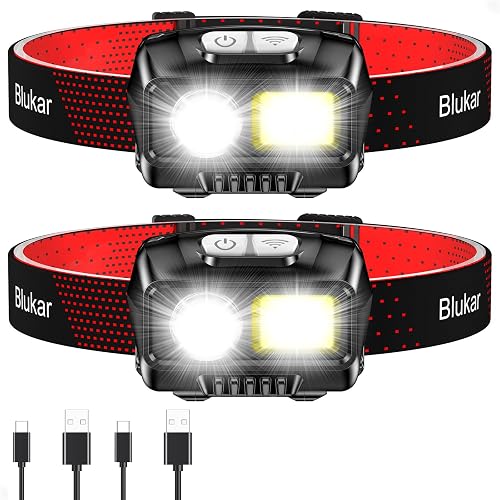
LHKNL Headlamp Flashlight Rechargeable with White Red Light, 2-Pack Waterproof
$19.99
Check price on Amazon →

LITEBAND PRO Multi-Beam Rechargeable LED Headlamp 2500 Lumens 210° Wide Beam
$119.99
Check price on Amazon →Tips for the morning of the climb
- Test it the night before, not at 3 AM: modes, strap fit, and charge level.
- Start out on medium mode, not high: it saves battery and you'll see plenty while following the group.
- Aim at the ground, 2-3 meters ahead, not at the horizon or the back of the head in front of you.
- Keep your backup accessible: batteries or power bank in the top pocket of your pack, not at the bottom.
- Lock your headlamp inside your pack (or take the batteries out) during the trip: arriving with a dead battery because it switched itself on in the boat is an avoidable classic.
Frequently asked questions
How many lumens does a headlamp need for climbing a volcano?
Between 200 and 400 real lumens are enough for volcano trails in Guatemala. With 200 lumens you can see the trail clearly 3-4 meters ahead; 300-400 give you margin for loose-ash sections or fog. More than 500 lumens is rarely used and drains the battery much faster. Be wary of cheap headlamps advertising 1000+ lumens: the number is almost never real.
Is a USB rechargeable or battery-powered headlamp better for Guatemala?
For most travelers, USB rechargeable with a backup power bank. San Pedro La Laguna, San Marcos, and Panajachel have electricity in accommodations, but power outages are frequent; charge your headlamp the afternoon before and carry a small power bank. If you'll spend several days without an outlet (for example camping on Acatenango), a hybrid model that also takes AAA batteries is the safest option.
Can I climb San Pedro volcano with my phone's flashlight?
It's not recommended, and many guides won't accept it as gear. A phone flashlight doesn't leave your hands free, gives off little light, drains the battery you'll need for photos and emergencies, and if you drop the phone in the dark the problem doubles. A basic headlamp from a good brand costs little and solves all of that.
What is the red light on a headlamp for?
Red light doesn't dazzle: it lets you check your pack, read the map, or talk to the group without blinding anyone or ruining night vision, which takes up to 30 minutes to recover. At the summit it also lets you wait for sunrise without polluting other people's photos with light. It's a near-mandatory mode on group climbs before dawn.
This article contains affiliate links. As an Amazon Associate, we earn from qualifying purchases at no extra cost to you.