Best Inflatable Sleeping Pad for Camping at Lake Atitlán
20 July 2026 · Diego Monzón
Add us as a preferred source on Google
As an Amazon Associate, I earn from qualifying purchases. That said, this guide comes from actually camping at Lake Atitlán, in the department of Sololá, and from watching plenty of travellers ruin a night over the same mistake: a great sleeping bag paired with a mediocre pad.
Here is the part almost nobody explains. The lake sits at roughly 1,562 metres above sea level. Daytime weather is friendly, 15 to 25 °C, so you assume the night will match. It will not: once the sun drops behind the San Pedro volcano the temperature falls fast, and on clear dry-season nights (November to April) it can approach 10 °C. And the cold that actually wakes you up does not come from the air, it comes from the ground. You are lying on soil or volcanic sand that conducts heat far better than air, and your sleeping bag compresses flat under your body, so underneath you it insulates almost nothing. The pad is what does that job.
How I picked these sleeping pads
I filtered with five criteria aimed specifically at camping in the lake basin and around it:
- R-value (insulation): it measures how well the pad separates you thermally from the ground. For the lakeshore in the dry season an R-value of 2 to 3 is enough; if you are heading up the flanks of the Atitlán volcano (3,537 m) or Tolimán (3,158 m), go for 4 or more.
- Thickness: at least 5 cm if you sleep on your back, and 7 to 10 cm if you are a side sleeper, because your hip and shoulder sink through and end up on the rock.
- Type: pure inflatable (lightest and most packable), self-inflating (comfier and tougher, but heavy and bulky) or closed-cell foam (indestructible and cheap, though uncomfortable and huge).
- Built-in pump: inflating by mouth at this altitude genuinely wears you out, and it pushes the moisture from your lungs inside the pad, which breeds mould over time.
- Weight and packed size: nearly everything here moves by public boat (Q10 to Q25 between villages) and then on foot up steep streets. A big bundle is paid for with your back.
If you are still building out your kit, look at the right sleeping bag too: pad and bag work as one system, and a good one without the other gets you nowhere. And if you have not picked a spot yet, this guide on where to camp near the lake will save you some wandering.
1. KASBAH colchoneta de dormir extra ancha de 6 pulgadas

This is the pick for anyone unwilling to compromise on comfort. At 6 inches thick and wider than standard, it solves the classic side-sleeper problem: your hip never reaches the ground, not even on the uneven volcanic rock common on the beaches over toward Santiago and San Lucas. It also works best if you camp as a couple or if you are a larger build and ordinary pads leave an arm hanging off.
The trade-off is bulk. Packed, it takes up noticeably more room than an ultralight, and it is not what I would choose for a long walk between villages. Its natural home is the camp you reach by boat or by car and where you plan to stay two or three nights. If your priority is waking up without a sore back to head out early to the viewpoint, this is the safe bet.
2. Colchoneta de dormir ultraligera con almohada y bomba integrada

This model is the balance most backpackers arriving at Atitlán are after: light, packable, and with two details you appreciate every night, the built-in pillow and the integrated pump. The pump is not a catalogue gimmick: blowing a pad up at this altitude leaves you dizzy, and here you solve it by stepping or pressing for a couple of minutes, without filling the interior with the moisture of your breath.
It is honest about what it offers: it is not as plush as a 15 cm pad and does not pretend to be. If you sleep strictly on your side and carry more weight than average, you may want something thicker. But if you are hauling a pack from the Santa Cruz dock to the campsite, every gram you leave behind shows, and this is one of the least noticeable to carry.
3. Colchoneta ultraligera inflable con almohada y bomba

Very similar in philosophy to the previous one, with even more emphasis on weight and packed size. This is the one I would recommend for a multi-day plan along the shoreline, sleeping one night in San Juan and the next in San Marcos, where your luggage travels with you on the public boat and then on foot up steep streets. It compresses so far that it leaves real room in the pack for what matters: water, a rain shell and the sleeping bag.
The thing to watch is insulation: ultralight pads in this range prioritise weight over R-value. In the dry season, on the lakeshore, they work fine. If your plan involves sleeping high on the flanks of the Atitlán or Tolimán volcanoes, consider laying a thin foam sheet underneath; it adds half a centimetre of thickness and a good deal of warmth for very little weight.
4. Colchoneta inflable de 4.7 pulgadas de grosor para camping

At 4.7 inches (about 12 cm) it lands in the sweet spot between the ultralights and the 6-inch giants. It is enough for a side sleeper not to bottom out, and it is still manageable to pack. If this is your first time camping and you do not yet know whether you will turn into a long-route backpacker or a weekend camper, this is the one least likely to disappoint.
The generous surface also helps when the ground slopes, which it usually does at the campsites near the shore, where almost nothing is perfectly flat. A local tip: always point your head uphill, and pitch the tent before midday, because once the Xocomil wind rolls in during the afternoon, setting up gear in a crosswind stops being fun.
5. FUN PAC colchoneta de dormir ultraligera con almohada y bomba
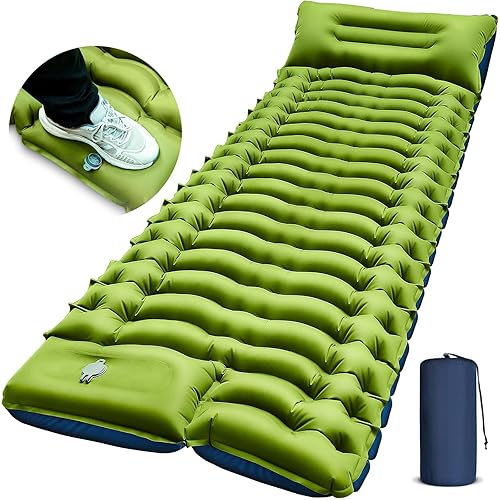
Closing the list is another ultralight with pillow and built-in pump, designed for the traveller who packs light and does not want loose accessories. The integrated pillow spares you the classic bundle of rolled-up clothes under your head, and the pump saves you from blowing when you arrive worn out after a three-hour shuttle from Antigua or three and a half from Guatemala City.
Like any lightweight pad, it asks for a little care: clear the ground of thorns and sharp stones before laying it out, or better, use a light groundsheet underneath. A puncture at midnight by the lake is not easily fixed, so always carry the patch that comes in the kit. With that minimum of attention, it is an excellent companion for several seasons.
Comparison table
| Sleeping pad | Profile | Built-in pump | Best for |
|---|---|---|---|
| KASBAH extra wide 6" | Maximum thickness and width | Not stated | Base camp, side sleepers |
| Ultralight with pillow and pump | Ultralight | Yes | Balanced backpacker |
| Ultralight inflatable with pillow | Minimum weight and bulk | Yes | Multi-village route |
| Inflatable 4.7" thick | Mid-range thickness | Not stated | First pad, mixed use |
| FUN PAC ultralight | All-in-one ultralight | Yes | Packing light, no extras |
Frequently asked questions
What is a sleeping pad's R-value and why does it matter at Atitlán?
The R-value measures how much the pad insulates you from the cold rising out of the ground: the higher it is, the less heat you lose. At Lake Atitlán you camp at roughly 1,562 metres above sea level, and even if the day hits 25 °C, the early hours can drop to around 10 °C while the soil or volcanic sand pulls heat from you all night. For the lakeshore, an R-value of 2 to 3 is usually enough in the dry season; if you plan to sleep on the flanks of the volcanoes or in cold weather, look for 4 or more. An excellent sleeping bag on an uninsulated pad is still a cold night: the system works as a whole or not at all.
How thick does my sleeping pad need to be to sleep comfortably?
At least 5 cm if you sleep on your back, and 7 to 10 cm if you sleep on your side, because your hip and shoulder sink in and end up touching the ground on thin pads. Models from 4.7 to 6 inches (12 to 15 cm) are the ones that best forgive terrain with stones or roots, very common at the improvised campsites around Santa Cruz or San Marcos. Thickness does not replace insulation, but it does decide whether you get up rested to climb Indian Nose at dawn or spend the night turning over.
Inflatable or self-inflating?
A pure inflatable is the lightest and most compressible: ideal if you are arriving by boat and then walking to camp with everything on your back. A self-inflating pad has foam inside, unrolls itself in a few minutes, insulates better passively and takes more abuse, but it weighs and packs considerably bigger. If your plan is camping near the car or the dock in Panajachel, the self-inflating gives you more comfort for less money. If you are walking between villages or climbing a volcano, the inflatable wins outright.
Does it get cold at night camping at Lake Atitlán?
Yes, more than people expect from a lake ringed by volcanoes in Guatemala. The typical range for the area runs 15 to 25 °C, but that high is a midday figure: at the lake's altitude the temperature drops fast once the sun sets, and on clear dry-season nights (November to April) it can approach 10 °C, with more wind if you are exposed on the shore. Add the humidity off the lake and it feels colder still. That is why ground insulation counts for so much here.
Is a built-in pump worth it?
Yes, especially here. Inflating a pad by mouth takes 15 to 25 deep breaths, and at 1,562 metres that genuinely makes you light-headed, more so if you have just hiked in with a pack. On top of that, the air from your lungs carries moisture that breeds mould inside the pad over time. A built-in pump, an inflation sack or a small electric pump settles it in a couple of minutes, with no moisture and no gasping. If the model you like does not include one, add a separate inflation bag: it weighs little and changes the experience.
In short
If you camp near the dock or the car and want to sleep like you are at home, go for the thickest and widest. If your plan is moving between Panajachel, San Marcos, San Juan and Santa Cruz carrying everything, any of the ultralights with a built-in pump will give you the best balance of rest and weight. Whatever you choose, pitch the tent before the Xocomil rolls in during the afternoon, lay a groundsheet under the pad, and remember that ground insulation is half your warmth. At 1,562 metres, that half decides whether you wake up ready for sunrise over the lake or counting the hours.