The Best Rain Jackets for Guatemala's Rainy Season
01 July 2026 · Diego Monzón
Add us as a preferred source on Google
If you're planning a trip to Guatemala between May and October, one piece of gear will decide whether you enjoy the trip or endure it: a good rain jacket. During the rainy season — what locals call winter, even though temperatures stay mild — it rains almost every day, but in a very particular pattern: sunny, clear mornings and intense afternoon downpours that last an hour or two. That rhythm completely changes what kind of jacket you should bring.
In this guide we explain how to choose the best rain jacket for a trip to Guatemala: what "waterproof" really means (and why many jackets that promise it aren't), which features matter for the climate around Lake Atitlán and the highlands, and when a poncho makes more sense than a jacket. At the end you'll find our picks, tested by travelers.
What rain in Guatemala is actually like (and why it matters for your jacket)
Guatemala's rainy season runs from May to October, peaking in June and September. But it's not the constant European-style drizzle: the typical pattern at Lake Atitlán, Antigua and the highlands is bright sunshine from 6 a.m. to noon, clouds building over the volcanoes in the early afternoon, and a heavy — sometimes torrential — downpour between 2 and 6 p.m. that lasts one to two hours. Afterwards, it often clears up again.
This has three practical consequences for your packing:
1. The jacket spends more time in your backpack than on your body. You'll carry it around all morning without using it. That's why packability and weight matter as much as waterproofing: a 200–300 gram jacket that compresses to the size of an apple is an infinitely better travel companion than an 800 gram parka, no matter how waterproof the parka is.
2. When it rains, it POURS. A seasonal downpour in Atitlán can drop in one hour what other cities get in a week. "Water-resistant" jackets give up within minutes. You need true waterproofing, with sealed seams.
3. It's (almost) never cold while it rains. Unlike mountain rain in Europe or North America, here the rain falls at 15–20 °C. You don't need an insulated jacket; you need a light outer layer you can throw on over a t-shirt. The real cold arrives at night and in the early morning because of the altitude — for that, check our guide on what to pack for the cold high-altitude climate at Lake Atitlán.
Truly waterproof vs "water-resistant": the waterproof rating
Here's the technical detail that separates a smart purchase from a soaked disappointment. A fabric's waterproofing is measured by its waterproof rating (hydrostatic head), expressed in millimeters: the water pressure the fabric can withstand before letting moisture through.
A quick guide to reading the labels:
0–1,500 mm (water-resistant / repellent): handles a light drizzle for a few minutes. Useless in a Guatemalan downpour. Many "windbreaker" jackets fall into this range, whatever the marketing suggests.
5,000 mm: moderate rain, short exposure. Barely enough for the tropics in the rainy season.
10,000 mm or more: this is the minimum we recommend for Guatemala in the rainy season. It withstands heavy, sustained downpours.
20,000 mm or more (Gore-Tex and equivalents): expedition level. Excellent, though for a tourist trip it's usually more than you need — and more expensive.
Just as important as the fabric: sealed seams (taped or fully taped seams). A 10,000 mm fabric with unsealed seams lets water in through every stitch. Look for "fully taped seams" in the product description. And check the zippers: a waterproof zipper or a storm flap makes all the difference when a downpour catches you crossing the lake by boat.
Breathability: the feature almost everyone forgets
A plastic bag is 100% waterproof, and nobody would want to hike in one. Breathability — measured in g/m²/24h, how much sweat vapor the fabric lets escape — is critical in Guatemala because the rain falls in mild temperatures with high humidity. In a jacket that doesn't breathe, you end up just as wet on the inside (from sweat) as if you'd worn nothing at all.
For walking between villages, climbing the steep streets of San Pedro or San Marcos, or doing easy hikes in the rain, look for at least 5,000–10,000 g/m²/24h. Membranes like Gore-Tex Paclite, Pertex Shield or in-house membranes from brands like Columbia (Omni-Tech) and Marmot (NanoPro) do the job well. A huge plus: underarm zip vents (pit zips), which let you regulate temperature without taking the jacket off. If you're planning to climb volcanoes, breathability stops being optional: see our hiking gear guide for San Pedro volcano, where the effort and altitude demand more from your technical clothing.
Weight and packability: the garment that lives in your backpack
Remember the pattern: sun in the morning, downpour at 3 p.m. Your jacket will spend 90% of the trip packed away. That's why criterion number two (after true waterproofing) is how small and light it gets:
Ideal weight: under 350 grams. The best travel rain jackets weigh between 180 and 300 grams. Above 500 grams you start thinking twice before putting it in your daypack... and that's the day the downpour catches you.
Packable / stuffs into its own pocket: many models compress into their own pocket or come with a stuff sack, ending up the size of an avocado. Perfect for keeping it in your small backpack at all times, right next to your water bottle.
Adjustable hood with a brim: non-negotiable. The wind on the lake blows hard during storms (the famous Xocomil), and a hood without drawcords keeps blowing off. A structured brim keeps the water from running down your face.
Jacket or poncho? The great Guatemalan debate
In any village on the lake you'll see locals and travelers wearing ponchos, and it's a fair question: why spend money on a technical jacket when a Q25 poncho does the trick? Both have their place.
Poncho advantages: it also covers your backpack (a huge plus if you carry a daypack with a camera and electronics), it ventilates massively from below (zero trapped sweat), it's dirt cheap and you can buy one at any corner store the moment it starts raining. For getting from the comedor back to your hostel, it's unbeatable.
Poncho disadvantages: in the wind of the lake's storms it turns into a sail — it lifts, it sticks, it flips over. On a boat it's a straight-up guarantee of getting soaked from below. For walking longer distances or hiking trails it's awkward and snags on vegetation. And the cheap ones tear on the second use.
Our traveler recommendation: bring both. A packable rain jacket as your main layer — for boats, walks and days of exploring — plus a cheap poncho bought locally as backup to protect your backpack in the heaviest downpours. Together they weigh less than 500 grams and cover every scenario.
Quick checklist before you buy
A summary of what your jacket needs for Guatemala's rainy season: a waterproof rating of 10,000 mm or more (truly waterproof, not just "resistant"), fully taped seams, breathability of 5,000 g/m²/24h or more (ideally with pit zips), weight under 350 grams and packable into its own pocket, an adjustable hood with a brim, and waterproof or storm-flap zippers. Tick those six boxes and no Atitlán downpour will bother you.
Our picks
These are the models that best balance true waterproofing, weight and price for a trip to Guatemala in the rainy season:
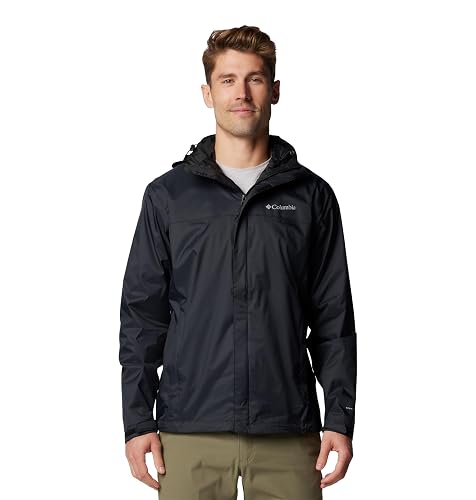


APEXUP Packable Rain Jacket Men with Reflective Zipper, Lightweight Waterproof
$19.99
Check price on Amazon →

Frequently asked questions
Does it rain all day in Guatemala during the rainy season?
No. The typical pattern from May to October is a sunny morning and an intense afternoon downpour, usually between 2 and 6 p.m., lasting one to two hours. Mornings tend to be perfect for tours, volcanoes and boat rides; plan outdoor activities early and carry the jacket in your backpack for the afternoon.
What waterproof rating does a jacket need for Guatemala's downpours?
We recommend a minimum of 10,000 mm hydrostatic head with fully taped seams. Water-resistant jackets (under 1,500 mm) soak through within minutes in a tropical downpour. Between 10,000 and 20,000 mm you're more than covered for any storm of the season without paying expedition-gear prices.
Is a poncho better than a rain jacket for Lake Atitlán?
For short walks, a poncho works and protects your backpack. But in the wind of the lake's storms (the Xocomil) and on the boats, a poncho blows around and becomes impractical. The ideal combination is a packable rain jacket as your main layer plus a cheap locally bought poncho to protect your luggage.
Do I need an insulated jacket for the rain in Guatemala?
Not for the rain: downpours fall at mild temperatures of 15–20 °C, so a light waterproof shell over your normal clothes is enough. The real cold shows up at night and in the early morning because of the altitude (Atitlán sits at 1,560 m); for that you'll want a separate thermal layer.
This article contains affiliate links. As an Amazon Associate, we earn from qualifying purchases at no extra cost to you.