The Best Trekking Sandals for the Villages of Lake Atitlán
20 July 2026 · Diego Monzón
Add us as a preferred source on Google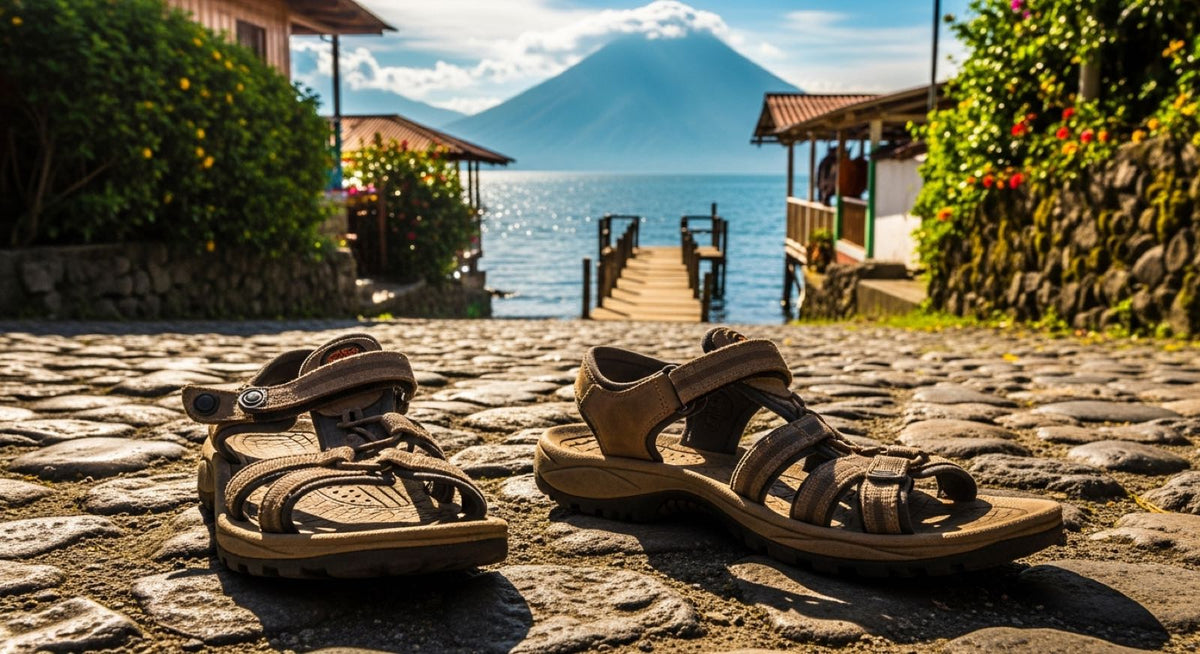
As an Amazon Associate, I earn from qualifying purchases. After several seasons walking around Lake Atitlán, I have a conviction that outdoor catalogs will not like: for the lakeside villages, a trekking boot is almost always overkill. What you actually need is a trekking sandal that grips when wet, protects your toes and dries on its own.
The lake sits in the department of Sololá, at roughly 1,562 meters of altitude, ringed by three volcanoes — Atitlán (3,537 m), Tolimán (3,158 m) and San Pedro (3,020 m) — and by six main villages: Panajachel, San Pedro, San Marcos, San Juan, Santiago and Santa Cruz. None of them is a place you drive through. You walk them, on steep cobblestone streets, and you connect between them by boat, stepping onto wooden docks that stay permanently wet from the chop of the Xocomil, the wind that picks up every afternoon. If you are planning how to get around the lakeside villages, that single detail shapes your footwear more than anything else.
How I picked these sandals: four criteria that actually matter at Atitlán
1. Wet grip. This is criterion number one and it is not negotiable. Stepping off a public boat onto a soaked wooden dock, with the hull still moving, is the single riskiest moment of the whole trip. Look for soft rubber with multidirectional lugs and channels that push water out. A smooth foam sole, however comfortable it looks, is a trap.
2. Closed toe versus open toe. On cobblestones the closed toe wins, no argument. The stones in the streets of San Pedro or San Juan have sharp edges and they shift underfoot; one stubbed big toe on a downhill leaves you limping for the rest of the trip. An open toe breathes better and feels nicer on the dock or the terrace, so it is a fair choice if your plan is mostly water and rest.
3. Fast drying. In the rainy season (May to October) the afternoon downpours are serious, and in any season your feet will get wet getting on and off the boat. Synthetics, mesh and polyester straps dry in an hour or two of walking. Thick leather does not: it stays damp, it gets heavy and it starts to smell.
4. Genuinely adjustable straps. You need to be able to cinch down on the climbs and loosen off when your foot swells from heat and altitude. A system that locks the heel keeps your foot from sliding forward on descents, which is the number one cause of blisters and black toenails.
When does a sandal NOT work? When the plan includes a summit. Climbing any of the three volcanoes calls for a mid-cut boot, a stiff sole and ankle support: these are long slopes of loose ash, and it gets genuinely cold up top. If that is your week, look into which boots work for climbing volcanoes in Guatemala and bring both pairs. The sandals still earn their place on the other five days.
Plaka Explore — the most versatile for walking all day

The Plaka Explore is the sandal I would recommend to someone landing in Panajachel with a single bag who wants one pair to solve the whole trip. It is a walking and hiking sandal built for women, with a contoured footbed that supports the arch and straps that adjust at several points — exactly what you need when the cobblestones force you to walk on a tilted foot for blocks at a time.
Who it is for: travelers doing the classic lake circuit — boat, village, market, viewpoint — with one or two hours of walking a day. The heel hold stops the dragging that wrecks your toes on the descent from San Marcos down to the dock.
The good: it dries fast, it does not soak up odor the way leather does, and it weighs almost nothing in the pack. The honest part: it is a strap sandal, not a closed-toe one, so on cobblestones with loose rock you will want to watch your footing. It is also not the pick if your plan involves carrying a heavy pack for several kilometers.
Mishansha hiking and water sandal — closed toe for the cobblestones

If I had to pick a single sandal for the lakeside villages, it would be a closed-toe one, and this Mishansha model is the archetype: protected toes, heel locked by a strap, lugged sole. It is a hybrid between a water shoe and a trekking sandal, which is precisely the blend Atitlán demands.
Who it is for: travelers combining boat rides and walking on the same day. You step off at the Santa Cruz dock with wet feet, climb the trail up to the village, and twenty minutes later you are dry. The closed toe is what makes it beat a classic sandal: on cobblestone streets, one banged toe ruins three days of your trip.
The honest part: being closed, it breathes less than an open-strap sandal, and in the hottest hours (temperatures hover between 15 and 25 °C, but high-altitude sun at 1,562 m hits hard) you feel it. It is also worth trying on with a thin sock the first time: the material takes a couple of wears to give.
Hike Footwear HF BareSandals — minimal, for a trained foot

This is the barefoot option: thin sole, zero drop, wide toe box and almost no cushioning. The idea is that your foot works and reads the terrain, which on irregular stone can give you a lot of stability… if your foot is already used to it.
Who it is for: people who already walk or run in minimal footwear. On the cobbles of San Juan or the short trails between Santa Cruz and Jaibalito, the thin sole gives you ground feel and forces a clean footstrike, which cuts down on slips. It is also the lightest and flattest pair to pack.
The honest part: if you are coming from thickly cushioned sneakers and you put these on for day one of the trip, your arches will be sore by evening. That is not a flaw in the product, it is adaptation. And on long descents with a pack, the lack of cushioning shows. Buy it only if you already know what you are getting.
WateLves with sport strap — the cheapest one that handles water

The WateLves is the budget sandal that does the job. It has the stretch upper of a water shoe, an adjustable strap over the instep and a textured sole that drains. It is not an alpine product and does not pretend to be: it is a decent amphibious shoe at throwaway-shoe money.
Who it is for: someone spending three or four days at the lake, doing mostly boat rides, kayaking, a coffee tour and short walks inside the village, who does not want to invest in a technical pair. It also works very well as a second pair while your main one dries out.
The honest part: the sole is softer than that of a real trekking sandal, so on trails with big rock you will feel the ground in an unpleasant way, and it wears out sooner. The strap helps, but it is no substitute for a properly designed heel-hold system. As dock-and-village footwear, excellent value.
Mishansha non-slip sole — the safe bet for the docks

This second Mishansha model bets everything on the sole: rubber with multidirectional lugs and drainage channels, which is exactly the feature that matters when you step off a public boat onto a soaked wooden dock. That moment — wet plank, moving water, people waiting behind you — is where most people fall at Atitlán.
Who it is for: travelers using the boats daily, which is basically everyone: transport between villages costs between Q10 and Q25 and is the normal way to move. If you are getting on and off boats four times a day, put wet grip ahead of everything else.
The honest part: the fit runs snug, so if you have a high instep go up half a size. And although it handles short trails, do not buy it planning half-day walks with elevation: there is more structured footwear for that.
Quick comparison table
| Model | Toe | Best for | Weak point |
|---|---|---|---|
| Plaka Explore | Open | Walking the village all day | Toes exposed on loose rock |
| Mishansha hiking and water | Closed | Combining boat rides and cobblestones | Breathes less at midday |
| Hike Footwear HF BareSandals | Open | A foot already trained in minimal shoes | Almost no cushioning |
| WateLves with strap | Closed | Budget and second pair | Soft sole, less durable |
| Mishansha non-slip sole | Closed | Daily boat and dock use | Snug fit over the instep |
Frequently asked questions
Do trekking sandals work for the villages of Lake Atitlán?
Yes, and for most travelers they are the most practical option. The villages of Lake Atitlán — Panajachel, San Pedro, San Marcos, San Juan, Santiago and Santa Cruz — are covered on foot, on steep cobblestone streets, wet wooden docks and short trails between communities. A trekking sandal with a lugged sole and adjustable straps covers 90% of the trip without the weight or the heat of a boot, and it dries itself after you climb into the boat. The exception is long high-altitude hikes, where closed, stiff footwear really is the right call.
Closed toe or open toe for cobblestone streets?
Closed toe, without question. The cobblestones in the Atitlán villages have loose stones and sharp edges, and one stumble on a downhill is all it takes to smash your big toe. A closed toe also shields you from dust in the dry season (November to April) and from mud in the rains (May to October). An open toe ventilates better and is more comfortable on the dock or the beach, so it is a fair pick if your plan is mostly boats, kayaks and terraces. If you are walking between villages, go closed.
Can I climb a volcano in trekking sandals?
No. Volcán Atitlán (3,537 m), Tolimán (3,158 m) and San Pedro (3,020 m) mean long slopes of loose ash, roots, dirt steps and real cold at the top. For that you need a mid-cut boot with ankle support and a stiff sole; a sandal leaves your foot exposed to rock and does not hold the ankle on the descent, which is where most sprains happen. Save the sandals for the villages and bring proper footwear if the plan includes a summit.
Do they slip on wet docks?
It depends entirely on the sole. The lake docks are wood or concrete and they stay wet from the chop of the Xocomil, the strong wind that rises every afternoon. Look for soft rubber with multidirectional lugs and channels that evacuate water; that design bites well on damp wood. What does slip is a smooth foam sole or hard, worn-out rubber. And one piece of common-sense advice: step off the boat landing flat-footed, never on your toes and never running.
Sandals or water shoes for the lake?
They are different tools. A water shoe is a neoprene sock with a thin sole: perfect for getting into the lake, climbing into a kayak or walking on rocks underwater, but uncomfortable for walking a kilometer uphill. A trekking sandal has a cushioned midsole and load-bearing straps, so it handles real walking and also gets wet without complaint. If you are only bringing one pair, make it the trekking sandal; if you do a lot of kayaking or swimming, a cheap water shoe as a second pair is worth it.
Conclusion: one closed pair with a good sole solves the trip
If you take one idea away from this guide, make it this: at Lake Atitlán the enemy is not distance, it is surface. Irregular stone, wet wood and constant gradient. A closed-toe trekking sandal with a lugged sole covers 90% of what you will actually do — stepping off the boat in Santiago, climbing the hill in San Marcos, crossing the short trail to Jaibalito — without the weight, the heat or the bulk of a boot. Save the boot for the volcano, if you climb one. For everything else, sandal.
One last practical tip: break the pair in at home before you travel, even if it is only two short walks. No new strap forgives an eight-hour first day on cobblestones.