Packing Cubes for Backpacking: The Central America Guide
01 July 2026 · Diego Monzón
Add us as a preferred source on Google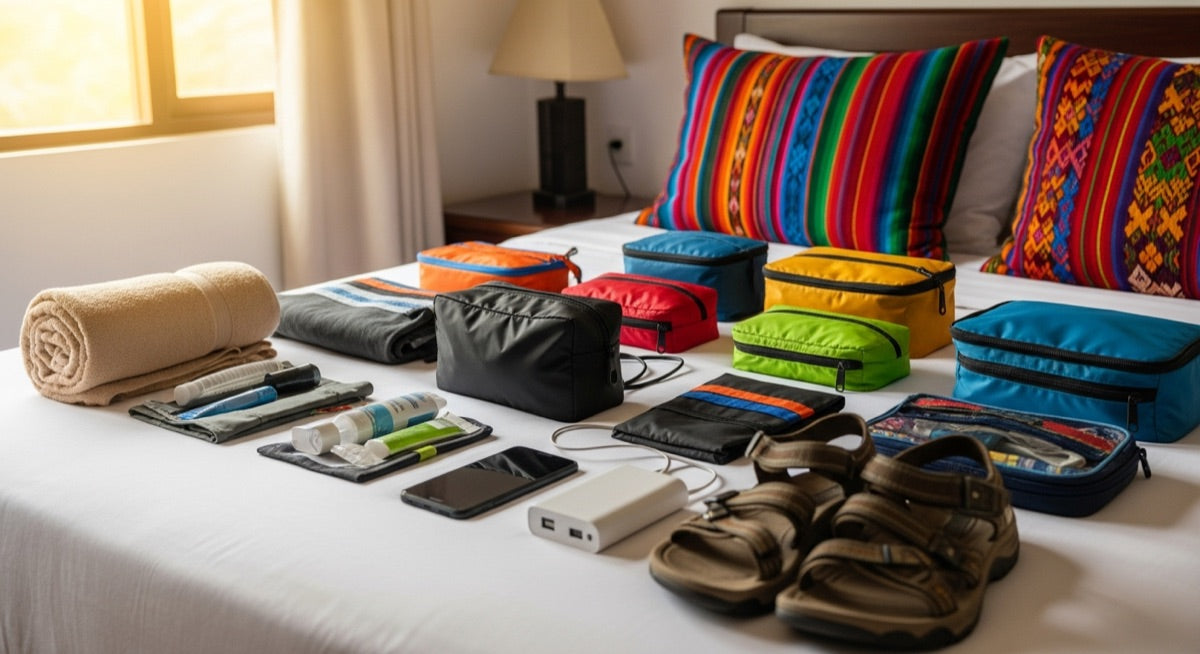
Anyone who has lived for weeks out of a 40-liter backpack in Central America knows the scene: it's 5:50 in the morning, the boat to San Pedro leaves in ten minutes, and you're on your knees in the hostel dumping your ENTIRE pack onto the bed because your phone charger sank to the very bottom. Packing cubes and luggage organizers exist precisely so that never happens again.
In this guide, drawing on the experience of traveling around Lake Atitlan and the rest of Guatemala, we cover which types of organizers exist, which ones make sense for rainy weather and boat rides, and how to build a system that lets you find anything in seconds without unpacking your whole bag.
Why packing cubes change a backpacker's life
A travel backpack is, in essence, a sack: one deep compartment where everything sinks and gets shuffled around. Packing cubes turn it into a dresser with drawers. Each cube is a module: one for t-shirts and pants, another for underwear, another for dirty laundry. When you need something, you pull out the right module, grab what you're looking for and put it back. The pack never gets emptied, never explodes onto the bed of a shared dorm.
After weeks on the road, the concrete benefits come down to four:
- Order that survives the trip. Day-one tidiness usually dies by the third city. With cubes, the system maintains itself because everything has its module.
- Finding everything without emptying the pack. Crucial in hostels with shared dorms, pre-dawn departures and boats that don't wait.
- Separating dirty and damp clothes. In Atitlán's rainy season (May to October), wet clothing is a constant. A dedicated cube or bag keeps a damp t-shirt from passing its smell and moisture to everything else.
- Compression = extra space. Compression models push the air out of your clothes and free up as much as a third of the volume. In a 40L, that's the difference between closing your pack and wrestling with it.
Compression vs. standard packing cubes: which one you need
This is the first and most important buying decision. Both organize, but they work differently.
Standard cubes are rectangular zippered pouches of lightweight fabric. They're cheaper, weigh less (30-80 g each) and usually have a mesh top panel to see the contents and let them breathe. They're perfect if your pack has room to spare or you're chasing minimum weight.
Compression cubes add a second zipper around the perimeter. You fill the cube, close the main zipper and then the compression one: the piece flattens like an accordion and pushes out the air trapped in the clothes. The typical result is 20-30% less volume. Clothes come out slightly more wrinkled — nothing a night on a hanger in Atitlán won't fix — and each piece weighs and costs a bit more.
Our verdict for Central America: if you travel with 40L or less, compression isn't a luxury, it's a necessity. The winning combination is 1-2 compression cubes for bulky clothing (sweaters for the cold high-altitude nights, jeans) and standard cubes for the small stuff. If you're still deciding what clothes to bring for the lake's weather, check our guide on what to pack for Lake Atitlan and its chilly high-altitude climate: the nights at 1,560 meters catch more than a few people off guard.
Dry bags: the organizer the rainy season demands
Around Lake Atitlan you get around by boat. And on a public lancha, your backpack rides in the bow or under the seat, catching spray from the lake and, in the rainy season, downpours that start without warning in mid-afternoon. This is where your organizing system needs a piece that regular cube sets don't include: the dry bag.
A roll-top dry bag of 5 to 10 liters does double duty:
- Protection inward: phone, passport, charger and cash travel sealed during the San Pedro–Panajachel crossings even when the boat slams against the afternoon chop (the famous Xocomil).
- Isolation outward: it works in reverse as a quarantine bag — the wet swimsuit, the damp towel or the soaked boots go inside and the moisture never touches the rest of your luggage.
Look for dry bags made of TPU or coated nylon, with welded (not sewn) seams and a top that rolls down at least three turns. Thick PVC ones are cheaper but too heavy for backpacking; ultralight silnylon ones are ideal if you count every gram.
Cable and electronics organizer: the module that prevents the snake's nest
The bottom of every disorganized backpack hosts the same fauna: a knot of USB cables, the charger, earphones, power bank, adapters and a loose SD card that will resurface three countries later. An electronics organizer — a semi-rigid case with internal elastics, mesh pockets and dividers — solves this once and for all.
What to look for in a good one:
- Crossed elastics to hold each coiled cable separately.
- A padded pocket for a power bank or hard drive.
- Double layer if you travel with a drone, a Kindle or lots of gear; single layer if you only carry a phone and charger.
- Water-repellent exterior: around Atitlán, all your electronics appreciate an extra barrier. The most cautious travelers put it inside the dry bag on boat days too.
It's the module with the best cost-to-peace-of-mind ratio on the whole list: it costs little, weighs little and eliminates 90% of the "where's the charger?" scenes in dark hostel rooms.
How to build your system for a 40L backpack
After plenty of trial and error, this is the system we recommend for living out of a 40L for weeks in Central America:
- Large compression cube: main clothes — t-shirts, pants, a sweater for the lake's cold nights.
- Medium standard cube: underwear, socks, swimsuit.
- Small cube or ventilated bag: dirty laundry. Some sets include a specific piece with a mesh panel; if not, any cube you "sacrifice" for that role works.
- 5-10L dry bag: electronics and documents on boat days; wet clothes when needed.
- Cable organizer: all the small electronics in one place, always in the same pocket of the pack.
Golden rule: each module always lives in the same spot in the pack. Main clothes at the bottom, dirty laundry against your back (damp weight near your center of gravity), electronics on top and within reach. Within a week, your muscle memory finds everything in the dark — literally.
And if the problem isn't just organization but the backpack itself, we have a full guide to the best travel backpacks for Central America with the sizes and access styles that work best on this route.
Our pick of organizers for backpackers
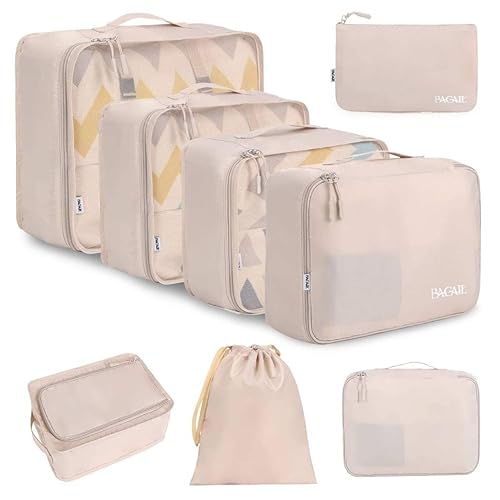
These are the organizers we recommend by type, chosen by the logic of travel in the region: compression to gain space, standard for the light stuff, dry bags for the lake and cases for electronics.

Compression Packing Cubes for Travel, 6-Piece Lightweight Set for Carry-On & Backpacks
$39.95
Check price on Amazon →


Common packing cube mistakes (and how to avoid them)
Buying cubes bigger than your backpack. A large cube from a set designed for a 60L suitcase doesn't sit well in a 40L. Check the dimensions against your pack before buying; "travel size" sets or 3-piece small-medium sets usually fit better.
Filling them halfway. A half-empty cube is a shapeless bag that shifts around and wastes space. Cubes work when full: clothes rolled tight, giving them structure. If you have space left over, use a smaller cube.
Using compression on delicate technical clothing. Down jackets or softshells can ride compressed for a few days, but weeks of continuous compression degrade the insulation. Give them a standard cube or keep them out of the modules.
Ignoring ventilation in the dirty-laundry cube. Sweaty clothes sealed in waterproof fabric for days = a fungus farm and an impossible smell. The dirty module must breathe (mesh) and, if something is truly wet, it goes in the dry bag until you can hang it out.
Frequently asked questions
Are packing cubes really worth it, or are they an unnecessary expense?
If you travel for more than a week out of a single backpack, yes. They turn your pack into drawers: you find any piece of clothing in seconds, keep dirty laundry separate, and with compression models you gain 20-30% more space. For weekend getaways, you can skip them.
How many organizers do I need for a 40-liter backpack?
A set of 3 to 4 pieces: a large cube for your main clothes, a medium one for underwear and socks, a small one or a bag for dirty laundry, plus a separate cable organizer. With more pieces in a 40L, the cubes themselves start to get in the way.
What's the difference between a compression packing cube and a standard one?
The standard one groups and organizes; the compression one adds a perimeter zipper that squeezes the contents and pushes the air out, reducing volume by up to a third. It weighs and costs a bit more, and wrinkles clothes slightly more, but in 35-45L backpacks the space you gain is more than worth it.
Do dry bags work as organizers in the rainy season?
Yes, and around Atitlán they're almost mandatory from May to October. A 5-10L dry bag protects electronics and documents on the boats, and works in reverse to isolate wet clothes from the rest of your luggage without moisture seeping through.
This article contains affiliate links. As an Amazon Associate, we earn from qualifying purchases at no extra cost to you.