What Does Atitlán Mean? The Origin of the Lake's Name
16 July 2026 · Diego Monzón
Add us as a preferred source on Google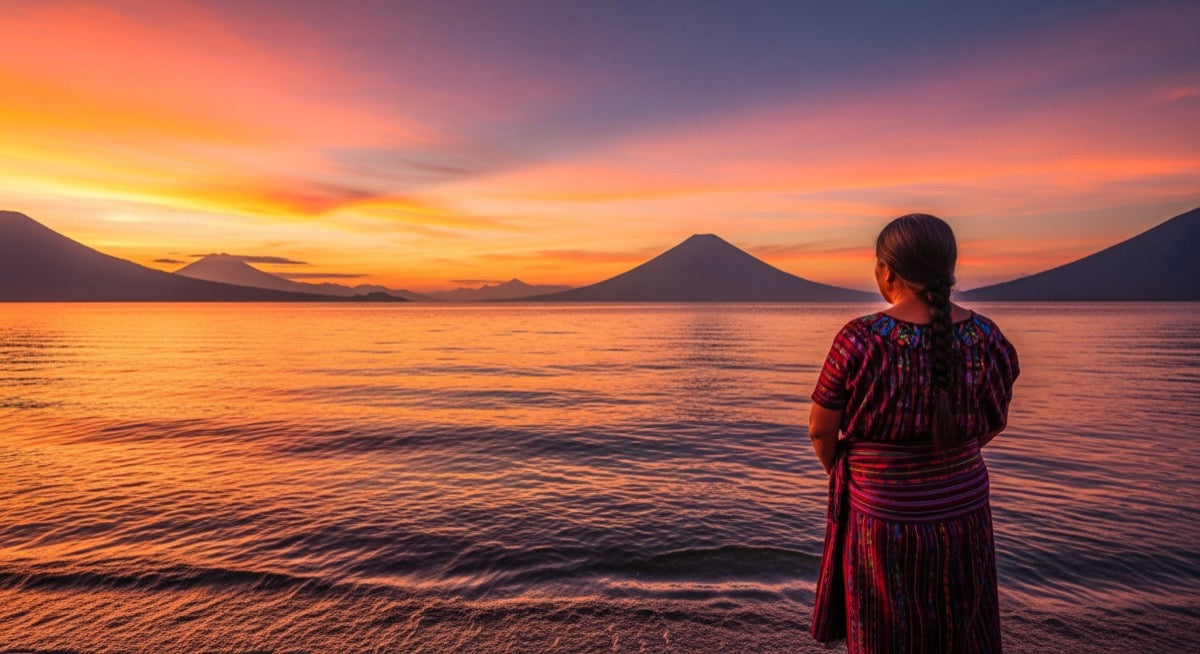
Few names evoke as much as Atitlán. Long before it became a haven for backpackers, yoga retreats and Maya villages, it was a word: a precise description of an impossible landscape. To understand what Atitlán means is to peer into the linguistic history of Guatemala, where the Nahuatl of the Mexica met the Maya languages of the highlands. Here is the story behind the name of Central America's most beautiful lake.
What does Atitlán mean?
Atitlán means "between the waters" or "place where water abounds." The name comes from the Nahuatl atl (water) plus the postposition titlan (between, next to). It is a literal description of the huge volcanic lake, set among mountains and crowned by three volcanoes, in the department of Sololá, in Guatemala's western highlands.
It is not a metaphor dreamed up by tourism brochures: it is exactly what the word says. Whoever named the place saw a great body of water surrounded by more water —rivers, springs, the flooded caldera itself— and called it, simply, "between the waters."
The Nahuatl origin of the name
Nahuatl was the lingua franca of Mesoamerica: it was spoken by the Mexica of central Mexico and, in Guatemala, by the Pipil, a people of Nahua origin who settled in the region. Many Guatemalan place names we use every day are in fact Nahuatl words adapted into Spanish during the conquest and the colonial period.
The structure is always similar. Atl ("water") appears in dozens of Mesoamerican place names. The ending -titlan —which you will also recognize in Tenochtitlan— indicates position: "between," "in the middle of," "next to." So Atitlan reads transparently as "between the waters." Over time, Spanish added the accent and the capital letter, but the root remains intact.
What did the Maya call the lake?
Here is the detail that surprises many travelers: the peoples living on the lakeshore are not Nahuatl speakers but Maya. In Santiago Atitlán and San Pedro they speak Tz'utujil; in Panajachel, Sololá and San Antonio Palopó, Kaqchikel; and K'iche' is spoken across the region too. These are three of the most vibrant Maya languages in Guatemala.
In those languages the lake is named with their own expressions tied to water and to the sacred geography of the place. Yet the place name that prevailed on maps and in official use was the Nahuatl "Atitlán," inherited from contact between Nahua peoples and from the Spanish colonial record. It is a fine reminder that a single place can carry, in layers, the memory of several cultures. If you want to experience that blend of languages and traditions firsthand, check out what to do at the lake and plan your journey through its villages.
A name worthy of the landscape
The meaning makes even more sense once you know the place. Lake Atitlán fills a volcanic caldera formed by a super-eruption some 84,000 years ago, reaches nearly 340 meters deep —the deepest in Central America— and is watched over by the Atitlán, Tolimán and San Pedro volcanoes. All of it sits about 1,562 meters above sea level, in an eternal-spring climate.
- Meaning: "between the waters" / "place where water abounds."
- Language of origin: Nahuatl (atl + titlan).
- Local Maya languages: Kaqchikel, Tz'utujil, K'iche'.
- Location: department of Sololá, western highlands of Guatemala.
So the next time someone asks what Atitlán means, you have both the short and the long answer: two Nahuatl words that, together, perfectly describe one of the most beautiful lakes in the world.
Frequently asked questions
What does the word Atitlán mean?
Atitlán means "between the waters" or "place where water abounds." It is a literal, poetic description of the vast lake ringed by mountains and volcanoes that gives its name to the whole region.
What language does the name Atitlán come from?
It comes from Nahuatl, the language of the Mexica and of the Pipil peoples who spread it across Mesoamerica. It is built from atl (water) and titlan (between): literally "between the waters."
What did the Maya call Lake Atitlán?
The Maya peoples on the shore speak Kaqchikel, Tz'utujil and K'iche', not Nahuatl. In their languages the lake is named with expressions that also refer to water and the great body of the lake; the Nahuatl place name "Atitlán" became the official name during the colonial era.
What does Atitlán mean in Nahuatl?
In Nahuatl atl means "water" and titlan is a postposition meaning "between" or "next to." Together, Atitlan translates as "between the waters."
Why is it called Lake Atitlán?
Because the name precisely describes what you see: an immense body of water set "between the waters" of the volcanic caldera. The Nahuatl speakers who reached Mesoamerica named the place this way, and the name endured to this day.