Best GoPro Accessories for Paragliding Over Lake Atitlan
09 July 2026 · Diego Monzón
Add us as a preferred source on Google
Paragliding over Lake Atitlan is one of the most breathtaking experiences Guatemala has to offer. Taking off near Panajachel or Santa Catarina Palopo and hanging in the air facing the three volcanoes —Toliman, Atitlan and San Pedro— with the deep blue water below is the kind of moment you want to relive a thousand times. And to relive it, you have to film it well.
The catch is that a tandem flight lasts only a few minutes, there are no second takes, and you are at the mercy of the wind, the cold of the altitude and the very real chance of dropping something into the lake. A GoPro without the right accessories can leave you with shaky footage, a dead battery halfway through the flight, or worse, at the bottom of Atitlan. In this guide we go over the GoPro accessories for paragliding that truly matter when you fly over the lake.
Chest mount (chesty) vs. helmet vs. selfie
The most important decision is not which camera you bring, but where you film from. Each mount tells a different story of the flight.
Chest mount (chesty): the favorite of most pilots. Strapped to your torso, it captures your legs dangling in the void, the pilot's hands on the controls and the lake horizon in a stable, natural way. It is the shot that screams "I'm flying" without needing a pole, and it suffers less vibration than the helmet.
Helmet mount: gives you the "what I see" perspective, ideal for following your gaze toward the volcanoes or for shots looking down at the water. The downside: it amplifies every head movement, so if you look around a lot out of excitement, the video can feel dizzying.
Pole or selfie stick: the extended arm that frames you within the shot with the scenery behind. On a tandem it is usually handled by the instructor pilot, and it produces those "drone-style" shots where you, the paraglider and the whole lake are visible. A short, rigid pole vibrates less than a long one.
Our recommendation for Atitlan: if you can only bring one, go with the chesty. It gives the best balance of stability, context and that sense of vertigo. If your pilot offers to film you with a pole, take it as a complementary shot.

Chest Mount Harness Strap Chesty Compatible with GoPro Hero 13 12 11 10 9 8 7
$19.99
Check price on Amazon →

Chest Mount Strap Harness Chesty Compatible with GoPro Hero 13-4 Session
$9.99
Check price on Amazon →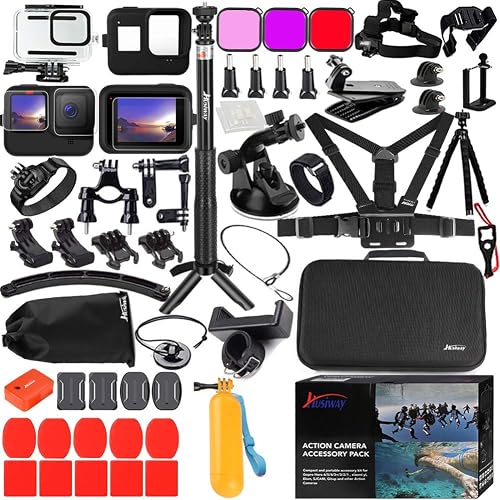
Accessories Kit for GoPro Hero 13 12 11 10 9, Waterproof Housing + Case + Screen Protector
$45.99
Check price on Amazon →
HONGDAK Action Camera Accessories Kit for GoPro Hero 13 12 11 10 9, Waterproof Housing
$29.99
Check price on Amazon →Safety first: leash and floaty so you don't lose your camera
This is not optional, it is the golden rule of filming over water. Lake Atitlan is extremely deep —over 300 meters in some spots— so anything that falls during the flight is gone forever. Two items save you from a tragic ending:
Leash (safety tether): a short cord connecting the camera or the mount to your harness, chest mount or helmet. If something comes loose —a clip, a badly tightened screw, an accidental knock— the camera hangs from the tether instead of plunging into the void. It is cheap, weighs nothing and is the difference between a scare and a total loss.
Floaty: a foam sleeve or adhesive that makes your GoPro float if it ends up in the water. Many flights in Atitlan land near the shore, and cameras are also handled on the boat or the dock. A brightly colored floaty also makes it visible if it drops. Combine leash + floaty and you practically eliminate the risk of losing it.
Field tip: before takeoff, give every mount and strap a firm tug. Once you are airborne there is no fixing it.
Spare batteries: the cold at altitude drains the charge
This is the mistake that ruins the most paragliding videos. People show up with the battery "half full" and halfway through the flight the camera shuts off. In Atitlan the problem gets worse: you fly at considerable height over a lake that is already more than 1,500 meters above sea level, and the cold air makes lithium batteries lose capacity much faster than normal.
- Bring at least two spare batteries charged the night before. Don't rely on just one.
- Keep the spares against your body, in an inner pocket near your body heat, not loose in a cold backpack.
- Record in the right mode, not the max. Recording in 5K at 60 fps devours the battery and heats up the camera; for paragliding, 2.7K or 4K at 30 fps performs much better.
- A multi-charger lets you get everything ready the night before from your hotel in Panajachel.
Waterproof housing: protection against water, dust and knocks
Modern GoPros already resist water without a case, but "resistant" is not "armored." To fly over Atitlan, a protective housing brings peace of mind if the camera gets wet on a landing near the water, if there is dust at takeoff, or if it takes a knock while packing and unpacking your gear.
You don't need a deep-dive housing to fly. What is worth it is a light protective housing or a frame with lens protection, which shields the most vulnerable part —the front glass— against scratches without adding weight. Watch out for sound: any sealed housing muffles the audio. If you care about capturing the silence of the flight or your reaction, use an open lens protector instead of a sealed housing; if your priority is maximum protection, the sealed housing is the safe choice.
Recommended recording settings for flying over Atitlan
The best accessory is useless if the camera is set up wrong. Get everything ready on the ground, because in the air you won't be fiddling with menus. These settings work best for paragliding over the lake:
- Stabilization at maximum. It turns a bumpy flight into smooth, cinematic footage.
- 4K or 2.7K resolution at 30 fps for the general footage; bump up to 60 fps only for a slow-motion shot.
- Wide field of view to fit volcanoes, lake and paraglider in a single frame.
- Lock the exposure if the sun hits hard on the water, so the glare off the lake doesn't darken your face.
- Turn the camera on before takeoff and confirm the recording light, so you don't miss the exact moment of liftoff.
- Clean the lens right before boarding: a fingerprint or dried drop ruins the whole recording.
With stabilization on and a wide frame, even a flight with mild turbulence looks spectacular. The key is to set everything up calmly before takeoff.
Prepare your flight and make the most of it
Filming your paragliding flight over Atitlan well comes down to three things: choosing the right perspective (the chesty rarely fails), securing everything with a leash and floaty so you don't donate your camera to the lake, and arriving with batteries to spare because the cold shows no mercy. Add a few well-thought-out settings and you'll have a memory worthy of one of the most beautiful views in the world.
If you haven't booked your flight yet, check out our complete guide to paragliding in Atitlan and Panajachel and the paragliding booking page for Atitlan to plan the experience. And if you also want aerial shots of your own, don't miss our guide to the best travel drone for photography in Guatemala.
Frequently asked questions
Can I bring my own GoPro on the Atitlan tandem flight?
Yes, most operators allow it as long as you secure it well with a leash or strap to the harness or a chest mount. Some pilots also offer to film you themselves with their own gear on a pole. Confirm the rules with your operator before takeoff, and never hold the camera with your hand alone.
Which mount gives the best paragliding shots?
The chest mount (chesty) is the most versatile: it captures your legs dangling, the pilot's hands and the lake horizon with stability. The helmet mount gives the first-person view but amplifies head movements. The pole or selfie stick, handled by the pilot, delivers drone-style shots where you appear with the whole landscape behind you.
Why does my GoPro battery drain so fast while flying?
The cold air at altitude makes lithium batteries lose capacity much faster, and recording at high resolutions with stabilization draws a lot of power. Bring at least two spare charged batteries, keep them close to your body to stay warm, and record in 4K at 30 fps instead of the max so they last longer.
Do I need a waterproof housing if I fly over the lake?
You don't need a deep-dive housing to fly, since you never go underwater. But a light protective housing or a lens protector helps against splashes, dust and knocks when handling the camera near the water. The truly essential items are the leash and the floaty: Atitlan is very deep and whatever falls in is gone for good.
This article contains affiliate links. As an Amazon Associate we earn from qualifying purchases at no extra cost to you.