Best Mosquito Repellent for Guatemala and Lake Atitlán
20 July 2026 · Diego Monzón
Add us as a preferred source on Google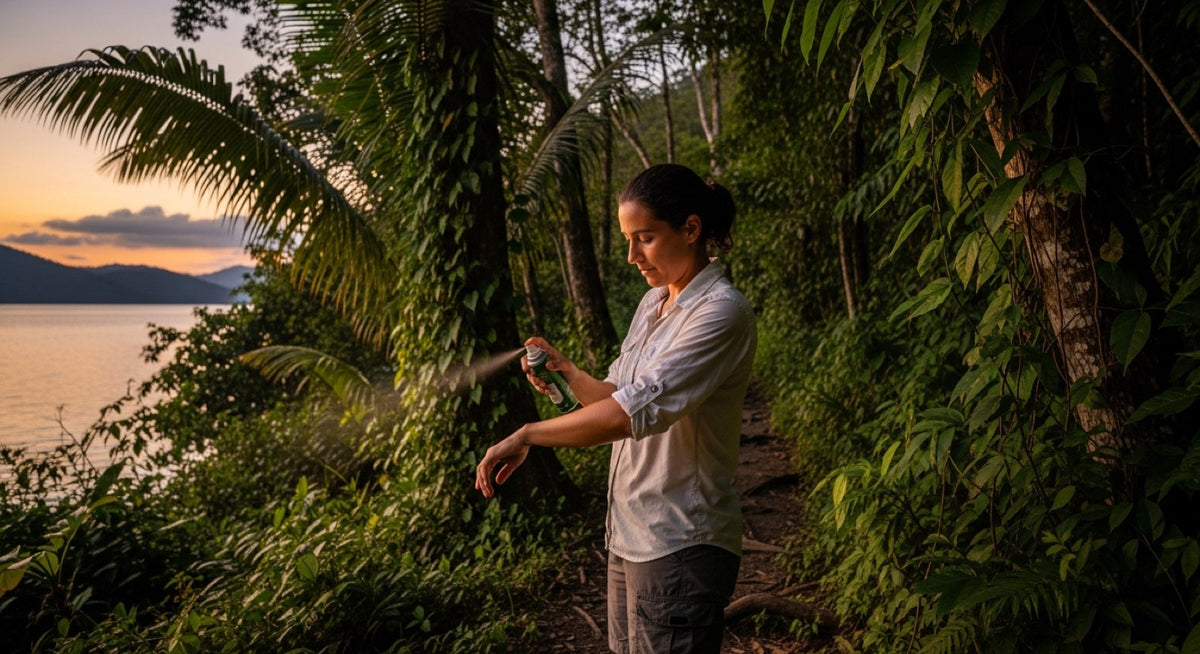
As an Amazon Associate, I earn from qualifying purchases. Let me start with something almost no "what to pack for Guatemala" article says out loud: Lake Atitlán is not an aggressive mosquito zone. At around 1,562 metres above sea level, with temperatures that rarely climb past 25 °C and a steady breeze that turns into the Xocomil wind every afternoon, the lake is far gentler than the Pacific coast or the jungles of Petén. But "fewer" is not "none", and there are very specific moments and places — the shoreline at dusk, the hotel gardens in Panajachel after three days of rain, the lower-lying villages — where you will be glad to have repellent in your daypack.
This guide comes out of years advising travellers heading into Sololá on what to pack. I ranked five real options against three criteria: which active ingredient they use and whether that level of protection matches the actual risk in the highlands; how practical they are to travel with (size, liquid or not, how they hold up to the damp of a boat crossing); and how honest their marketing is. I deliberately left out the military-grade 98% DEET products: they are overkill for Atitlán, they smell strong, they eat plastics and sunglasses frames, and they will not protect you better than a 20% formula.
DEET, picaridin and lemon eucalyptus oil: what to use and when
DEET is the classic benchmark and the most studied active. For areas where dengue is present, 20% to 30% is the recommended concentration; going higher does not increase protection, it only stretches how long it lasts. The downsides are sensory and material: a chemical smell, and it can damage plastics, glasses frames and synthetic fabrics.
Picaridin (also sold as icaridin) at 20% protects comparably to mid-strength DEET, but it is nearly odourless, does not leave skin sticky and does not attack plastics. For a highland trip — Atitlán, Antigua, Chichicastenango — it is probably the best balance of effectiveness and comfort, especially if you are carrying a camera, a phone and sunglasses all day.
The third group is natural repellents: lemon eucalyptus oil, citronella, geraniol, lemongrass. Two things need separating here. Refined lemon eucalyptus oil has genuine backing, though its protection is shorter and you have to reapply more often. Generic citronella-and-essential-oil blends last less still, maybe an hour or two. Do they work at Atitlán? For dinner in San Marcos or an afternoon on the dock in Santa Cruz, yes, as long as you are willing to reapply. For a whole night in the lowlands, no.
One piece of context that helps you decide: mosquito pressure at the lake changes dramatically with the season. Through the dry season from November to April you will barely think about it. Between May and October, which is the rainy season, puddles and humidity change the equation, particularly along the shoreline and in the lower villages such as Santiago Atitlán and San Pedro La Laguna.
Coleman Spray repelente de insectos SkinSmart sin DEET

Coleman SkinSmart uses IR3535 instead of DEET, an active with a solid reputation for tolerance on sensitive skin that does not attack plastics or synthetic fabrics. For a lake trip it strikes me as a sensible choice: medium-high protection without the smell or solvent effect of classic DEET, in a spray you can apply quickly before heading out to dinner. The honest downsides: it lasts less than a 30% DEET, so you will reapply if you are out all afternoon, and being an aerosol it is worth checking your airline rules before it goes in your carry-on. This is the default pick for anyone who wants something that works without smelling like a lab.
Murphy's Naturals Bálsamo repelente de mosquitos a base de plantas

This stick balm is the most travel-friendly option here and the one I recommend most specifically for Atitlán. Being solid, it does not count as a liquid in carry-on, it will not leak inside your bag when the boat bounces between Panajachel and San Pedro, and it applies precisely to ankles, wrists and the back of the neck — exactly where the bites happen at the lake. The formula is plant-based, lemon eucalyptus oil and company, with a pleasant herbal smell. The trade-off: you reapply every couple of hours, and covering a lot of skin with a stick takes time. Ideal as the repellent that permanently lives in your daypack, backed up by a spray for busier evenings.
Badger Spray repelente de mosquitos totalmente natural

Badger is a brand of simple formulas and it shows here: essential oils of citronella, lemongrass and rosemary in an oil base, no synthetic ingredients. This is the pick for travellers with small children, reactive skin, or anyone who would simply rather not put synthetics on their skin for a trip where the real risk is low. It genuinely smells good. Now the honest part: protection is short-lived and you have to reapply with discipline, roughly every hour to hour and a half if you are on the shore at dusk. It works for the highlands, for a daytime hike or for sleeping with the window open. I would not take it as my only defence to Río Dulce or Petén.
Cliganic Pulseras repelentes de mosquitos (paquete de 20)

Repellent bands deserve a clear explanation so you do not buy them expecting what they cannot deliver. They protect a limited zone around wherever you put them, they do not create a field around your body, and wind cuts their effect — relevant on a lake where the Xocomil blows almost every afternoon. That said, in the right context they are useful: one on each ankle while you have dinner on a terrace, or for a child who refuses spray. They come in a pack of twenty, so the per-unit cost is low and you can share them around the group. Think of them as a supplement, never as plan A.
EEZYSUN Protector solar SPF 50 con repelente de insectos, combo

This combo solves a very specific Atitlán problem: at 1,562 metres the sun is strong and you will spend hours out on the water, where it also reflects back at you. SPF 50 is non-negotiable and repellent is the second layer; carrying both in one package simplifies your packing. The technical caveat matters: even though they come together, apply them separately and in order — sunscreen first, wait fifteen minutes, then repellent — and reapply the sunscreen every two hours, especially after swimming or a boat crossing.
Quick comparison
| Product | Type | Format | Best for |
|---|---|---|---|
| Coleman SkinSmart | DEET-free (IR3535) | Spray | General highland use |
| Murphy's Naturals balm | Plant-based | Solid stick | Carry-on and boat rides |
| Badger natural | Essential oils | Spray | Sensitive skin and kids |
| Cliganic bands | Essential oils | Band (x20) | Ankle backup at dusk |
| EEZYSUN combo | Sunscreen + repellent | Combo | Full days on the water |
How to use it well at the lake
Three habits matter more than whichever product you buy. First, timing: apply before the sun goes down, not after you have already been bitten. The critical window at Atitlán is between the Xocomil dying down and nightfall. Second, coverage: the lake mosquitoes go for ankles and the tops of your feet, so if you are in sandals start there. Third, clothing: on rainy-season evenings, light trousers and long sleeves cut the problem more than any spray, and they double as warmth because at 1,562 metres the night really does cool off.
If you are staying on the shoreline, check that your room has a mosquito net or window screens and avoid leaving standing water on the terrace. These are common-sense measures that sit alongside the rest of the advice on health and safety at the lake.
Frequently asked questions
Are there a lot of mosquitoes at Lake Atitlán?
Fewer than people imagine. The lake sits at around 1,562 metres above sea level and temperatures hover between 15 and 25 °C, conditions considerably less friendly to mosquitoes than the Pacific coast or Petén. That said, they are not zero: along the shoreline and in the lower villages they do show up, especially between May and October. A small repellent in your daypack solves almost every case.
Do I need DEET repellent in Guatemala?
It depends where you are going. For Atitlán, Antigua and the highlands generally, a 20% picaridin formula or even a well-applied natural repellent is usually enough. If your itinerary includes hot lowlands — Petén, Río Dulce, the south coast, Semuc Champey — that is where 20% to 30% DEET is worth packing, the concentration recommended for dengue areas. Above 30% does not protect better, it just lasts a little longer.
When do mosquitoes bite most at the lake?
At dawn and above all at dusk, that golden half hour between the Xocomil settling and night falling, which is exactly when everyone is on a dock with a drink. Also after several consecutive days of rain, when puddles linger. At midday, with strong sun and wind, they are barely an issue.
Do repellent bands actually work?
They work in a limited way and it is only fair to say so. They protect the immediate area around a wrist or ankle, not your whole body, and their performance drops in wind. As a supplement — one on each ankle while you eat outside, or for a child who refuses spray on their face — they do the job. As your only defence on a humid August night, they do not.
Can I use repellent and sunscreen together?
Yes, and at Atitlán you will need both: at 1,562 metres the sun hits far harder than it feels. The rule is sunscreen first, wait about fifteen minutes for it to absorb, then repellent on top. Never the other way round. Two-in-one products are convenient for packing light, though sunscreen needs reapplying every two hours and repellent does not need that frequency.
In short: do not arrive at Atitlán afraid of mosquitoes, but do not arrive with nothing either. A solid balm in your daypack for everyday use, a backup spray if you are travelling in the rainy season, and sunscreen applied before repellent cover essentially every lake scenario. Save the 30% DEET for the day you head down to the coast or to Petén; in the highlands you will almost never need it.