Best Sunscreen for Altitude and Lake Atitlán: A Traveler's Guide
20 July 2026 · Diego Monzón
Add us as a preferred source on Google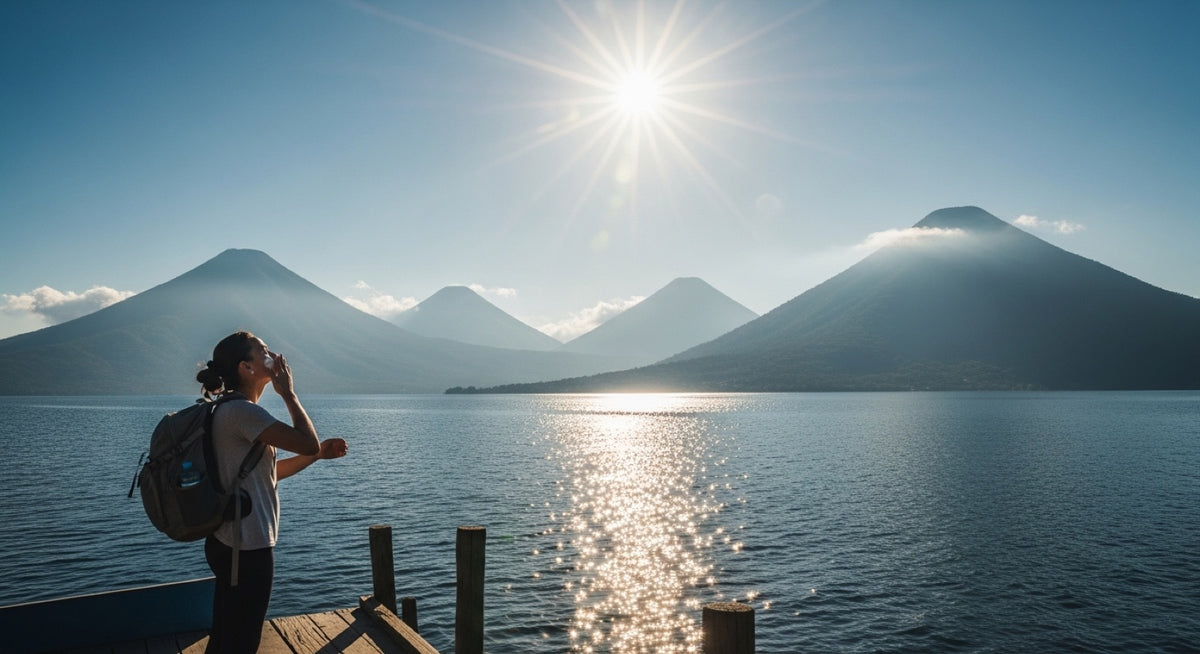
As an Amazon Associate, I earn from qualifying purchases. The most common mistake first-time visitors to Lake Atitlán make is packing the same sunscreen they use at the beach. The setting here is completely different: the lake sits at roughly 1,562 metres above sea level, ringed by the Atitlán (3,537 m), Tolimán (3,158 m) and San Pedro (3,020 m) volcanoes, with temperatures between 15 and 25 °C. That cool highland air means the sun never feels strong, and that is exactly the trap: ultraviolet radiation rises by around 10% for every 1,000 metres of elevation, and the surface of the lake bounces a large share of it straight back at your face while you cross by boat. The result is the classic Atitlán burn: red nose, ears, neck and the tops of your feet by day two.
In this guide we explain why the lake demands a different sunscreen, why we recommend mineral zinc oxide formulas over chemical ones, and we review five specific SPF 50 options that suit the kind of days people actually have here: public boats at Q10 to Q25 between villages, hikes up to the Mayan Face, early-morning kayaking and windy Xocomil afternoons. If you are still planning the trip, it is worth reading up on the weather and the best time to visit first, because the dry season from November to April concentrates the clear-sky days when exposure adds up without you noticing.
How we chose: the four criteria we applied
1. Mineral filter, not chemical. Zinc oxide and titanium dioxide form a physical layer on the skin and start protecting the moment you spread them, without the 15 to 20 minutes chemical filters need to absorb. On a dock where the boat leaves as soon as it fills up, that difference matters. Mineral formulas also irritate skin far less once altitude, wind and sweat have taken their toll.
2. SPF 50 minimum, broad spectrum. SPF only measures UVB protection; UVA damage — ageing and much of the long-term risk — is only covered if the label says broad spectrum. We ruled out anything that does not state it.
3. Real-world SPF, not just the label. Lab numbers are measured with 2 mg of product per square centimetre of skin, an amount almost nobody applies in real life. So we favour textures that spread easily: if a product is so thick you ration it, your effective SPF drops below half the number on the bottle.
4. Reef-safe, no oxybenzone or octinoxate. Atitlán is a closed volcanic lake up to 340 metres deep whose water never drains to the sea. Everything that rinses off your skin stays there. We prioritised formulas without those two chemical filters.
Sky and Sol Protector solar mineral SPF 50 con óxido de zinc

This is our pick as an all-day body sunscreen for boat days. The formula is built on zinc oxide, so it protects immediately and holds up well against the mix of sweat and lake spray that defines a midday crossing from Panajachel to Santiago. The texture is one of the more manageable among mineral options: you can apply a generous layer without rationing it, which is exactly what turns the SPF 50 on the label into real protection.
Who it is for: travellers spending several hours a day outdoors — kayaking, docks, hikes — who want one product for arms, legs, neck and feet. Honest drawback: like every zinc mineral, it leaves an initial white cast that takes a moment to settle, more visible on darker skin. That is the physics of the filter, not a flaw; the trick is thin successive layers rather than one thick one.
Banana Boat Mineral Sunscreen SPF 50 loción, 5 oz

The familiar-brand option in a practical 5-ounce size, ideal if you want something easy to replace. Being mineral, it fits the category we recommend for the lake, and the lotion format lets you see where you have already applied — something sprays do not allow, and the number-one cause of patchy burns.
Who it is for: anyone after the most direct value-to-coverage ratio, or travelling as a group and needing a bottle that stretches across two or three people for several days. Honest drawback: at 5 oz it exceeds carry-on liquid limits, so it goes in checked luggage. Its texture is also denser than the facial formulas below; for your face, pair it with one of those.
Protector solar facial mineral SPF 50 de óxido de zinc

A mineral built specifically for the face, which is where damage concentrates at Atitlán: your face takes direct sun and, on a boat, the bounce off the water as well. Because it is a facial formula the zinc oxide is milled finer and the finish is lighter than a body product, which means you reapply without dragging your feet — and reapplication is half the job.
Who it is for: travellers with combination or breakout-prone skin who cannot tolerate body sunscreen on the face. Also for anyone wearing sunglasses who does not want them sliding down. Honest drawback: facial formats give you less product per bottle and cost more per millilitre, so using it on arms and legs is not economical. It works best as the second product in your kit, not the only one.
CeraVe Protector solar mineral invisible SPF 50 facial

The safest bet if your skin is reactive. CeraVe builds its formulas around ceramides, which help hold the skin barrier together, and that detail matters more here than it sounds: between dry highland air, the afternoon Xocomil wind and sun dehydration, facial skin takes a beating fast. The invisible finish also solves the classic white-cast complaint about mineral sunscreens.
Who it is for: sensitive skin, rosacea, or anyone recently using retinoids; also for those who would rather not appear pale-faced in the San Marcos dock photos. Honest drawback: the finish leans luminous rather than matte, so very oily skin may read as shiny by midday. Blotting paper fixes it without removing the product.
Blue Lizard Protector solar mineral SENSIBLE con óxido de zinc SPF 50+

The most robust option on this list and our recommendation for swimmers. Its SPF 50+ zinc oxide formula for sensitive skin makes it a strong choice for water days in Santa Cruz or San Marcos, where you get in and out of the lake repeatedly. The brand is known for holding up to immersion, although — we insist — no sunscreen is waterproof: reapply when you get out, always.
Who it is for: swimmers, kayakers and families with children who need a tolerant formula without harsh chemical filters. Honest drawback: it is among the heaviest to apply and needs patient rubbing; with restless kids that means an extra minute of negotiation. In exchange, it is one of the hardest to wear off without noticing.
Comparison table
| Product | Where to use it | Best for | Keep in mind |
|---|---|---|---|
| Sky and Sol mineral SPF 50 | Full body | Long boat and hiking days | Initial white cast |
| Banana Boat Mineral SPF 50 (5 oz) | Body, family use | Groups and longer trips | Not carry-on friendly |
| Mineral SPF 50 zinc face sunscreen | Face | Frequent facial reapplication | Low yield for body use |
| CeraVe invisible mineral SPF 50 | Face, sensitive skin | Reactive skin and photos without cast | Luminous finish |
| Blue Lizard Sensitive SPF 50+ | Body, water | Swimming, kayaking and kids | Harder to rub in |
How to use sunscreen on a real day at Atitlán
Our own routine is simple. A generous first layer at the hotel, 15 minutes before heading out, covering face, ears, neck, hands and the tops of your feet — the four spots everyone forgets and precisely the ones that catch the reflection off the water. A second application before every crossing: the public boats between Panajachel, Santiago, San Pedro and San Marcos cost Q10 to Q25 and last 20 to 40 minutes each, but they stack up and easily add two hours of sun over open water in a single morning. And a mandatory reapplication after swimming or towelling off.
Sunscreen does not work alone: a wide-brimmed hat, UV sunglasses and a lightweight long-sleeved shirt do half the job and never wash off with sweat. If you want to build the full clothing and accessory kit for the lake climate, see our guide on what to pack for the lake, because crisp 15 °C mornings and windy Xocomil afternoons call for layers most people never consider when packing for "a lake in Guatemala".
Frequently asked questions
Why does the sun burn harder at Lake Atitlán?
Two reasons stack up. The first is altitude: the lake sits at around 1,562 metres above sea level, the atmosphere filtering ultraviolet radiation is thinner, and UV intensity climbs roughly 10% for every 1,000 metres of elevation. The second is reflection off the water: crossing by boat between Panajachel and San Pedro, the lake surface bounces much of that radiation back at you, so you get sun from above and below at once. That is why so many people burn at Atitlán even though the air feels cool at 15 to 25 °C: the temperature misleads you, the radiation does not drop.
Mineral or chemical sunscreen for the lake?
For Lake Atitlán we recommend mineral. Mineral sunscreens use zinc oxide or titanium dioxide, which sit on top of the skin and reflect radiation from the first minute, with no 20-minute absorption wait like chemical filters. They are also far less irritating when you are sweating in the sun or when the afternoon Xocomil wind dries out your face, and they do not sting your eyes. The environmental point matters too: Atitlán is a closed lake with no outlet to the sea, so everything that rinses off your skin stays in the water. A well-formulated mineral is the more responsible choice if you plan to swim in San Marcos or Santa Cruz.
What SPF do I need in Guatemala?
SPF 50 or higher, labelled broad spectrum (UVA + UVB). On the coast or in the city SPF 30 may be enough, but in the highlands with water reflection your margin for error shrinks dramatically. SPF 50 blocks about 98% of UVB versus 97% for SPF 30; that looks trivial on paper, but in practice almost nobody applies the amount labs use to measure that number, so the SPF you are actually wearing is always lower than the label. Starting at 50 gives you a buffer.
How often should I reapply on a boat?
Every two hours as a general rule, and immediately after swimming or towelling off, even if the product claims to be water resistant. On a boat reapplication matters even more, because wind and lake spray strip product away without you noticing, and because crossings between villages tend to chain together: Panajachel to Santiago, then San Pedro, then back. Hands, ears, the back of the neck and the tops of your feet are the spots everyone forgets and exactly the ones catching the bounce off the water.
What is reef-safe sunscreen and why does it matter here?
Reef-safe describes formulas without oxybenzone or octinoxate, two chemical filters linked to coral bleaching and the contamination of aquatic ecosystems. There are no reefs at Atitlán, but the principle applies just as much: it is a closed volcanic lake up to 340 metres deep whose water never drains to the sea. Every swimmer leaves product residue behind, and that residue accumulates. Choosing a mineral without those two ingredients is a concrete, cheap way to make your visit weigh less on the lake you came to enjoy.
Final thoughts
If you are only bringing one product, make it a zinc oxide mineral with SPF 50 and broad spectrum, in a bottle big enough that you never ration it. If you can bring two, the winning combination is a body mineral plus a facial one: body for arms, legs and feet, facial for reapplying on your face without that heavy feeling through the day. Everything on this list meets the reef-safe criterion, which in a closed 340-metre-deep lake like Atitlán is not a marketing detail but a decision that compounds visit after visit.
And the rule no product replaces: reapply every two hours. The Sololá sun does not warn you with heat — it warns you the next morning, in the mirror.