The Best Travel Hammocks for Lake Atitlán: A Nap with a Volcano View
01 July 2026 · Diego Monzón
Add us as a preferred source on Google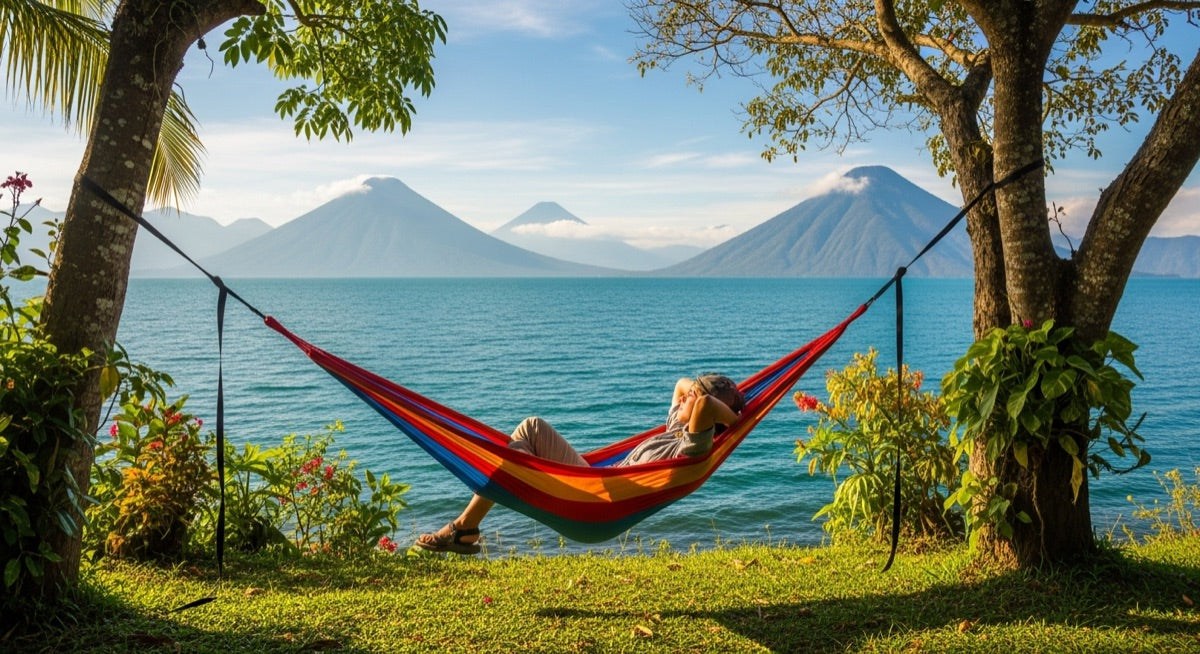
If there's one thing you learn fast traveling around Lake Atitlán, it's that nobody here is in a hurry. The hostels of San Pedro La Laguna have hammocks strung up facing the water, San Marcos has meditation platforms with volcano views, and even the smallest docks invite you to stay one more hour. At the lake, the hammock isn't an accessory: it's part of the culture. And when you carry your own travel hammock in your backpack, that culture travels with you — you can set up your nap spot on any beach, lookout or café garden between villages.
In this guide we'll tell you why a lightweight hammock (300–700 grams, less than a bottle of water) is one of the best buys for your trip to Atitlán, what the difference is between parachute nylon and handwoven Guatemalan cotton, and which details — straps, bug net, double size — are actually worth it.
Hammock culture at Lake Atitlán
Atitlán is, without exaggeration, hammock country. In San Pedro La Laguna almost every hostel in the lower part of town — the ones right on the water — has hammocks on its terraces, and they're the natural gathering point at sunset: people reading, sipping locally grown coffee and watching Volcán San Pedro turn orange. In San Marcos La Laguna the scene is more zen: hammocks between avocado trees and yoga platforms, perfect for a nap after swimming in the village's crystal-clear pools.
The catch is that hostel hammocks are always taken exactly when you want one. That's why well-traveled backpackers carry their own: it hangs between two trees in five minutes, weighs next to nothing and turns any corner of the lake into your private living room. A lonely dock in Santa Cruz? A lookout on the way up to Indian Nose? The shore after a swim? They're all hammock spots. If you plan to mix naps with swimming, check our guide to where to swim in Lake Atitlán: beaches and safe areas first to pick your base beach.
Why bring your own travel hammock to Atitlán
Beyond the romance, there are very practical reasons:
- Ridiculously light: a parachute-nylon hammock weighs 300 to 700 grams and packs down to the size of a grapefruit. In a travel backpack you won't even notice it.
- Nap anywhere: stone beaches, lookouts, hostel gardens, coffee farms. Wherever there are two trees (and Atitlán has plenty), there's a bed.
- A budget place to sleep: many hostels around the lake charge less for hanging your hammock on their terrace than for a dorm bed. In high season, when everything is full, it can save your night.
- Dries fast: nylon dries in minutes — key at a lake where you'll be in and out of the water all day.
- Zero ground contact: no rocks, no damp, no ants. In the lower, hotter spots, sleeping off the ground is a blessing.
Parachute nylon vs. handwoven Guatemalan cotton
Here comes the real decision, and in Guatemala it has a special twist, because the country produces beautiful handwoven hammocks.
Parachute-nylon hammock: the traveler
The logical choice for moving around. Ripstop nylon fabric (the same family of weave as parachutes), triple stitching, a load capacity of 180 to 220 kilos and a total weight that rarely tops 700 grams, stuff sack included. It packs into its own built-in sack, dries fast, shrugs off sun and humidity, and the double models fit two people watching the sunset just fine. If your trip involves boats, chicken buses and hikes between villages, this is your hammock.
Handwoven cotton hammock: the Guatemalan
In the markets of Panajachel, Chichicastenango or Antigua you'll find hammocks handwoven in cotton, with traditional colors and patterns no outdoor brand can imitate. They're heavier (1.5 to 3 kilos), slower to dry and not ideal for backpack travel, but as a souvenir and a home hammock they're unbeatable: cooler to the touch, wider, and with real cultural value, because you buy directly from local weavers. Our honest advice: carry a nylon one for the road and take a handwoven one home in your return luggage. They don't compete — they complement each other.
What to look for in a travel hammock for the lake
Tree straps included. The detail that separates a good buy from a frustration. Many cheap hammocks come with ropes only, which damage tree bark and are slow to adjust. Look for flat daisy-chain straps with multiple loops: they set up in a minute, don't hurt the tree and let you adjust the height without complicated knots. If they're not included, buy them separately — you'll use them every single time.
A bug net for the lowlands. At 1,560 meters of altitude, Atitlán has fewer mosquitoes than the coast, but the lakeshore, humid rainy-season nights and any side trip to lower ground (El Paredón, Río Dulce, Semuc Champey) bring them back. A hammock with an integrated zip-up bug net lets you sleep in peace and packs down just as small. If you plan to use the hammock as an alternative bed, consider it mandatory.
Double size even if you travel solo. Double hammocks (about 2 x 3 meters) weigh barely 100–150 grams more than singles and change everything: you can lie diagonally — the correct position to keep your back flat — wrap yourself up on cool highland nights and, of course, share the sunset. Almost nobody who buys a double regrets it; single buyers sometimes do.
Stitching and load capacity. Look for triple stitching and a declared capacity of at least 180 kg. Aluminum wiregate carabiners beat plastic hooks.
Integrated stuff sack. A sack sewn onto the hammock itself doubles as a pocket for your phone, book and sunscreen while you're lying down. Small detail, big difference.

Wise Owl Outfitters Camping Hammock up to 500lbs Portable with Tree Straps
$35.91
Check price on Amazon →
MalloMe Hammock Straps for Trees - Heavy Duty Adjustable Tree Strap Kit
$17.99
Check price on Amazon →
Wise Owl Outfitters Hammock Straps 10ft Heavy-Duty Tree Hanging Kit with Carabiners
$23.99
Check price on Amazon →
Foxelli XL Hammock Straps - Extra Long 20FT Heavy Duty Suspension System
$13.77
Check price on Amazon →
The best places to hang your hammock at Atitlán
- San Pedro La Laguna: the waterfront hostel terraces and the café gardens in the lower part of town. Guaranteed social vibe.
- San Marcos La Laguna: avocado trees and quiet gardens near the Cerro Tzankujil reserve. Perfect post-cliff-jump nap.
- Santa Cruz La Laguna: one of the quietest corners of the lake; docks and hillsides with a panoramic view of all three volcanoes.
- Jaibalito and Tzununá: small villages linked by trails; perfect for stringing up your hammock halfway along the Santa Cruz–San Marcos hike.
- Lookouts: Indian Nose at sunrise is the classic, but any high point on the northern trail delivers postcard views.
A note on temperature: highland nights drop to 10–15 °C, so if you plan to sleep in your hammock, don't count on a sheet alone. A good lightweight sleeping bag makes the perfect combo — we cover which one to choose in our guide to the best sleeping bags for Guatemala's tropics and highlands.
Quick tips on use (and respect)
- Always hang with flat straps, never with thin rope looped straight around the trunk: protect the trees that make the siesta possible.
- Aim for a 30-degree angle between strap and ground, with the lowest point of the hammock at chair height. Lie diagonally.
- Ask permission if the land belongs to someone — in the lake villages, a friendly "may I hang my hammock here for a while?" opens doors and conversations.
- Don't leave your hammock hanging unattended with your things inside; in touristy areas the same common sense applies as anywhere.
- Shake it out and dry it before packing it away; nylon forgives, mold doesn't.
Frequently asked questions
How much does a travel hammock weigh and how much space does it take up?
A parachute-nylon hammock weighs between 300 and 700 grams depending on whether it's a single or a double, and packed down it's about the size of a grapefruit. With straps included you rarely go over 1 kilo total — far less than carrying a sleeping pad or hoping to find a free bed.
Can I sleep overnight in a hammock at Lake Atitlán?
Yes, and several hostels in San Pedro and San Marcos allow it for less than a dorm bed. Just keep in mind that highland nights are cool (10–15 °C), so you'll need a sleeping bag or blanket, and in the rainy season a bug net and a roof (a covered terrace or a light tarp) are a good idea.
What's better: a nylon hammock or a handwoven Guatemalan cotton one?
For traveling, nylon: it weighs under 700 g, dries in minutes and handles the lake's humidity. The handwoven cotton ones from the markets of Panajachel or Chichicastenango are cooler, prettier and support local weavers, but they weigh 1.5–3 kg and dry slowly: buy one as a souvenir for your home, not for your backpack.
Do I need a bug net at Atitlán?
For daytime naps in the highlands, usually not. For sleeping overnight near the shore, in the rainy season, or if your route continues to lowland spots like El Paredón, Río Dulce or Semuc Champey, an integrated bug net is worth every gram: it adds barely 100–200 g and guarantees a buzz-free night.
This article contains affiliate links. As an Amazon Associate, we earn from qualifying purchases at no extra cost to you.