Best Travel Pillow for Shuttles and Mountain Roads in Guatemala
20 July 2026 · Diego Monzón
Add us as a preferred source on Google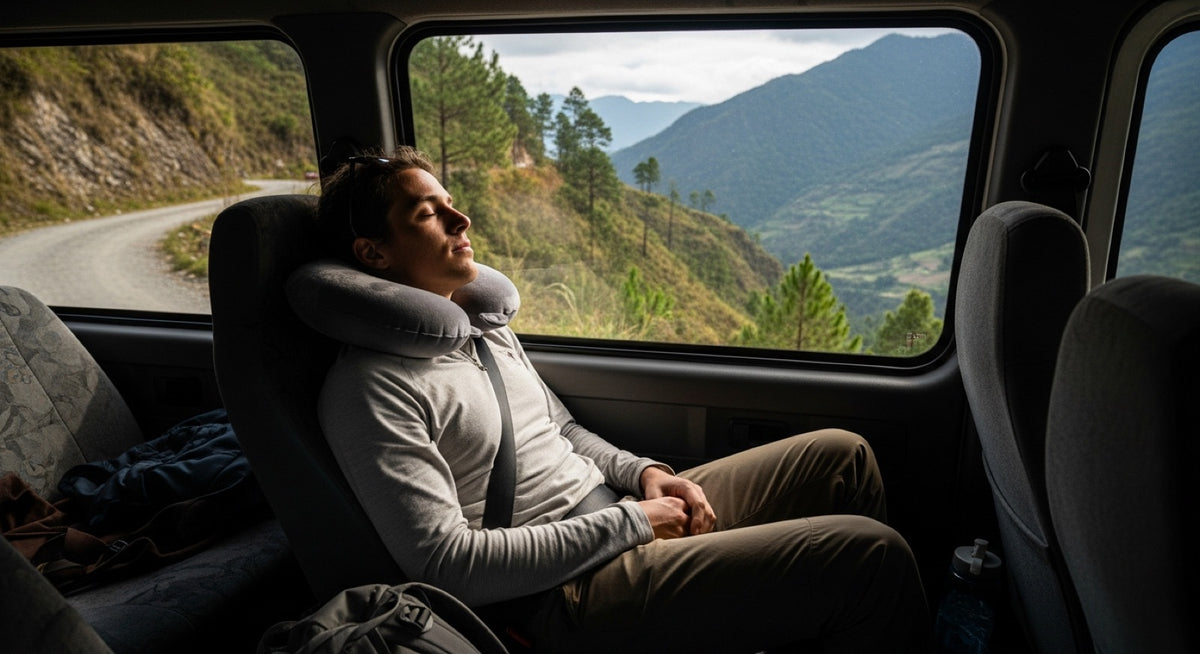
As an Amazon Associate, I earn from qualifying purchases. That said: if you are reading this, someone already warned you about the road to Lake Atitlán, or you have done it once and arrived in Panajachel with a locked-up neck. The shuttle from Antigua takes around 3 hours, and about 3.5 hours from Guatemala City. The final stretch is not a highway — it is a mountain road with one curve chained to the next as you climb and then drop into the lake basin, roughly 1,562 metres above sea level. In a 12-seat van, with the seat back upright and no room to recline, your head spends three hours falling sideways on every bend.
That is the actual problem, and naming it properly matters because it changes which pillow works. The classic travel pillow was designed for planes, where your head falls forward when you doze off. On a winding road it falls sideways, dozens of times an hour. A pillow that only stops forward nodding will do nothing for you between Chimaltenango and Sololá. What we cared about in this list is lateral support: how well the model blocks that ear-to-shoulder roll.
How we chose: four criteria
1. Real lateral support. The pillow has to be taller at the sides than at the nape. If it is an even tube, your head keeps rolling. 2. Material that does not give up. Good-density memory foam holds its shape under load for hours; microbeads flatten out, and inflatables swing between too soft and too hard. 3. Packed volume. If you are travelling with a 40-litre backpack, a pillow that eats 8 litres is a problem — a compression bag or an external clip is not a bonus, it is a requirement. 4. Double duty. Almost nobody walks to Guatemala: the same pillow has to work on the international flight, which is where it truly pays for itself.
The four types of travel pillow, without the marketing
The classic U wraps the neck and leaves the front open. It is the most common and the most misunderstood: in cheap bead-filled versions the U collapses and ends up pushing your head forward instead of holding it. In versions with dense memory foam and raised sides, it is the best road option.
The wrap style encircles the neck completely, sometimes with a front zip or velcro. It gives the best lateral support of the lot and lets you roll the least, but it is the warmest: on a shuttle without air conditioning, mid-morning climbing towards Sololá, you will feel it.
The inflatable packs down to the size of a fist and weighs almost nothing. Its problem is adjustment: the correct pressure sits in a very narrow band, and if you get it wrong the pillow works against you. Treat it as a backup, not the main one.
The chin-support type adds a front piece that holds the jaw so the head cannot drop onto the chest. Excellent for overnight flights and slightly overkill for three daytime hours — though if you are the type who falls asleep the moment the van pulls out, you will be glad of it.
Memory foam vs inflatable: the short answer
For the Antigua–Panajachel or Guatemala City–Panajachel leg, memory foam. The argument is not comfort but physics: memory foam absorbs the sideways momentum and dissipates it, while air gives it back. Three hours of curves are hundreds of small rebounds, and an inflatable returns every one of them to you. Memory foam weighs more (between 250 and 450 grams) and takes more space, and both costs are real, but a compression bag solves them. Next-day neck pain solves nothing.
Cabeau Evolution S3 almohada de viaje de espuma viscoelástica

It is the benchmark the others get compared to, and here the reputation is earned through one concrete design decision: the back is flat rather than bulky. That sounds minor, but it is what stops the pillow from pushing your head forward against the upright seat of a van — the classic failure of cheap U pillows. The sides are tall and the memory foam is dense, so it genuinely blocks the side-to-side movement that matters on the descent towards Sololá. It comes with a compression bag that cuts packed volume considerably, and the cover comes off for washing, which you will want after a week hopping between villages.
Who it is for: the traveller doing the international flight and then the shuttle, who wants to buy once. Downside: it is neither the cheapest nor the most compact, and if you have a short neck the tall sides can feel tight for the first few minutes.
Ostrichpillow almohada de cuello para viaje

The pitch here is different: it prioritises not looking or feeling like a medical brace. The textile finish beats the category average and the profile is more discreet, which in practice means you will not take it off out of embarrassment ten minutes in — a more decisive factor than it sounds, because the pillow you do not wear does nothing. Neck support is solid for lateral sway, without reaching the blocking power of a rigid wrap.
Who it is for: people travelling light who care that their gear looks good, and who mix the shuttle with public boats and walks between San Marcos and San Juan. Downside: if you want maximum support above all else, there are stiffer options on this list.
FlyHugz almohada cervical de viaje de espuma viscoelástica

Memory foam with the emphasis on cervical fit: the shape is built to fill the gap between the nape and the seat back, which is exactly where tension builds when you spend hours bolt upright. That detail matters more on a shuttle than on a plane, because in the van you have no recline to fall back on. The result is a pillow that spreads the weight of your head instead of concentrating it on two points, and that survives the full three-hour session without collapsing.
Who it is for: anyone who already arrived once with a sore neck and wants to fix it properly this time. It also works at a desk outside the trip. Downside: dense foam needs a few seconds to adapt to morning cold; on a 6 a.m. shuttle out of Antigua, give it a minute before judging it.
SAIREIDER almohada de viaje de espuma viscoelástica 100% pura

The selling point is material purity, and in travel pillows that really shows: plenty of budget pillows blend memory foam with fibre filling to cut costs, and that blend is what flattens within a month. Consistent foam throughout the volume means day-30 support equals day-1 support. For anyone doing the full circuit — flight, shuttle to Antigua, shuttle to Panajachel and back — that consistency is worth more than a few grams saved.
Who it is for: frequent travellers and anyone planning more than one long road transfer on the same trip. Downside: it is among the bulkiest of the group; without disciplined use of the compression bag it eats a serious chunk of a 40-litre pack.
SZXYX almohada cervical de viaje de espuma viscoelástica

It closes the list as the best support-per-price option. It is memory foam, cervical in shape, with sides that do their job of stopping the head from dropping, minus the finishes and extras of the models above. If your trip is short — land in the capital, sleep one night, take the shuttle to Panajachel and stay at the lake — this covers the case without much thought.
Who it is for: a first trip to the lake, a tight budget, or a second pillow for your travel partner. Downside: the cover and accessories are more basic, and expected lifespan is shorter than a Cabeau's if you travel every month.
Comparison table
| Model | Type | Lateral support | Best for |
|---|---|---|---|
| Cabeau Evolution S3 | Flat-back U, memory foam | High | Flight + shuttle, one single purchase |
| Ostrichpillow | Neck style, discreet profile | Medium-high | Travelling light between villages |
| FlyHugz | Cervical, memory foam | High | Upright seats with no recline |
| SAIREIDER | 100% pure memory foam | High | Several long transfers back to back |
| SZXYX | Cervical, memory foam | Medium-high | Tight budget / second unit |
How to pack it without losing half your backpack
Three rules that work. First, use the compression bag from day one and store the pillow rolled, not folded; the foam recovers its shape better that way. Second, if the pack is full, clip the pillow on the outside: on a shuttle the big luggage rides in the back of the van and you will not be able to dig it out halfway. Third, decide before you leave whether you are using it on the plane — if yes, it goes in your carry-on, not the checked bag, because landing at La Aurora with an already tired neck ruins day one.
One logistics detail people discover late: inside the lake almost all movement is by boat, not by car. If you are unsure how the villages connect, check our guide on how to get around the lake, because public boat crossings cost between Q10 and Q25 and take 15 to 45 minutes: there the pillow does little and what you need is a windbreaker, especially after midday when the Xocomil wind picks up. And if you are building a budget, our breakdown of how much the shuttle costs shows that ground transfer is one of the trip's fixed line items: if you are paying for it anyway, you may as well sleep through it.
Frequently asked questions
How long is the shuttle from Antigua to Lake Atitlán?
Antigua to Panajachel takes around 3 hours by tourist shuttle, and about 3.5 hours from Guatemala City. It is not a straight road: the final section is mountain driving with continuous curves as you climb and then descend into the lake basin, which sits at roughly 1,562 metres above sea level. Shuttles usually make one short stop, so you are looking at three near-continuous hours seated in a van with the seat back upright.
Is a travel pillow worth it for just 3 hours?
Yes, for one specific reason: it is not the duration, it is the motion. On a long flight your head falls forward; on a winding road it falls sideways, over and over, for hours. That lateral sway is what leaves your neck sore the next day. A pillow that blocks lateral movement solves exactly that problem, and it weighs under half a kilo. If you also flew into Guatemala, you already got double the value before you even reached the lake.
Memory foam or inflatable?
Memory foam wins on support: it holds its shape under the weight of your head and does not deform on every curve, which is exactly what you need on a mountain road. Inflatables win on packed volume, since they store down to fist size. The drawback of an inflatable is bounce: under-inflate it and it sinks, over-inflate it and it pushes your head forward, and finding the middle ground inside a moving van is uncomfortable. For this trip, memory foam.
How do I pack the pillow without filling my whole backpack?
Look for models that come with a compression bag; almost all the good ones do, and they cut volume by more than half. The other technique is not to pack it inside at all: most have a loop or carabiner for hanging off the outside strap of a backpack or a suitcase handle. On a shuttle it does not matter that it rides outside, and that way it stays within reach without opening the luggage stowed at the back of the van.
Will the same pillow work for the flight to Guatemala?
That is the best part of the maths. The same pillow you use on the shuttle to Panajachel works on the flight into La Aurora, on the way back, and on internal transfers between villages if you loop overland towards Santiago or San Pedro. Buy one good one and it covers the whole trip. Buying a cheap one at the airport and another one later costs more and works worse.
Conclusion
The road to Lake Atitlán is beautiful and it is long, and both are true at once. Three hours of curves with an unsupported head charge you the next day, right when you want to hike up to the viewpoint or cross over to Santiago. If you are buying only one, make it memory foam with tall sides and a compression bag — the Cabeau Evolution S3 is the safe bet, the FlyHugz the one most focused on the upright shuttle seat, and the SZXYX the budget exit that still does the job. Any of the three beats arriving in Panajachel unable to turn your head.
One last practical note: leave early. Morning shuttles catch less traffic getting out of the capital and drop you in Panajachel before the afternoon wind complicates boat crossings. With a pillow and an early start, the transfer stops being the worst part of the trip.