Best Waterproof Dry Bag for Boat Trips on Lake Atitlán
09 July 2026 · Diego Monzón
Add us as a preferred source on Google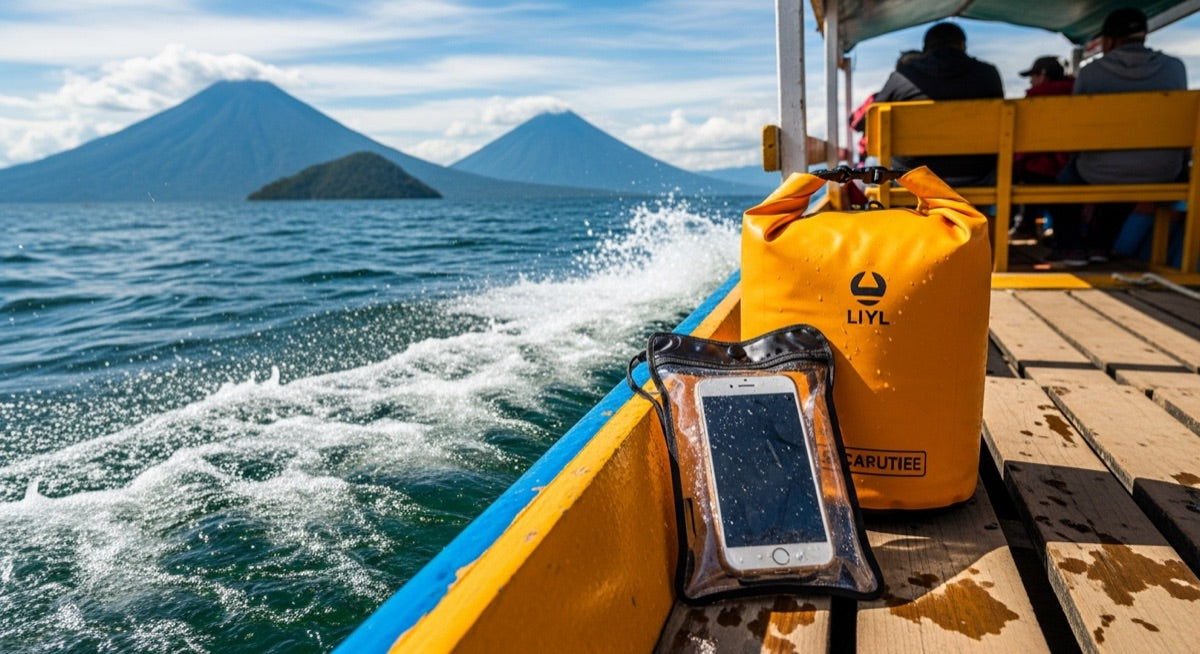
Crossing Lake Atitlán on a public boat is one of the most beautiful experiences in Guatemala: fresh air, volcanoes in the background and villages appearing one after another along the shore. But there is one detail almost nobody warns you about before you climb aboard the panga: you are going to get wet. Water jumps over the sides with every wave, and in the afternoon, when the Xocomil wind kicks in, the bow throws up curtains of spray that soak backpacks, phones, cameras and even your passport. Here we explain, as people who cross it every week, what the best waterproof dry bag for the boat is and how to choose the right size so you reach the dock dry.
Why you need a dry bag on Lake Atitlán
Atitlán is not a calm pool. It is a crater lake ringed by three volcanoes, and its microclimate changes fast. In the morning the water is usually like a mirror, but from around midday the Xocomil wind starts to blow, kicking up waves half a meter high or more. The public boats are fast, run loaded and jump over every wave: the result is water splashing constantly, especially if you end up sitting at the front.
Add to that the sudden rain of the wet season (May to October), the splashes as you get on and off slippery docks, and the fact that many travelers combine the ride with kayaking or paddle boarding. In all of those scenarios a normal backpack —even a "water-resistant" one— will not hold up. A roll-top sealed dry bag does: it keeps your phone, wallet, documents and change of clothes completely dry even if the bag ends up floating in the water.
Dry bag by liters vs. floating phone pouch
Not everyone needs the same thing. There are two different tools and the ideal is to combine them:
The dry bag (measured in liters) is the main sack where you stuff everything: clothes, towel, camera, charger, snacks. It closes by rolling the mouth down three or four times and clipping the buckle, which creates an air chamber that also makes it float. It is your "safe" against the water for the whole trip between villages like Panajachel, San Pedro, San Marcos or Santiago.
The floating phone pouch solves the other problem: you want to use your phone without taking it out. Look for one with an IPX8 rating (submersible) and a touch-sensitive window on both sides, so you can take photos, check the map or reply to a message without exposing the device. Many include an air chamber so it floats if you drop it in the lake; that, in Atitlán, with nearly 340 meters of depth, is the difference between getting your phone back or losing it forever.
The winning combo for the lake: a medium dry bag for the day's gear and an IPX8 pouch hung around your neck for the phone in use.
What size dry bag to choose (liters by plan)
The most common mistake is buying a giant bag that gets in the way on the boat, or one so small the camera won't fit. This is our quick guide by liters:
5 to 10 liters: ideal for a short crossing or half a day. Fits a phone, wallet, documents, a small towel and sunscreen. Perfect for hopping between two or three villages.
15 to 20 liters: the most versatile size for a full day of boat touring around the villages. It fits a change of clothes, a towel, a camera with a lens, snacks and a light jacket for the wind.
30 liters or more: for those carrying kayak gear, light camping equipment or moving between lodgings in different villages. It usually comes with backpack-style straps for your back.
Local tip: a backpack with padded straps is comfortable for walking from the dock to the hotel, but inside the boat a cylindrical bag with a side handle is easier to hold between your legs when the panga bounces.


Pelican Marine Waterproof Phone Pouch, Touchscreen IP68 Floating, 2 Pack
$29.95
Check price on Amazon →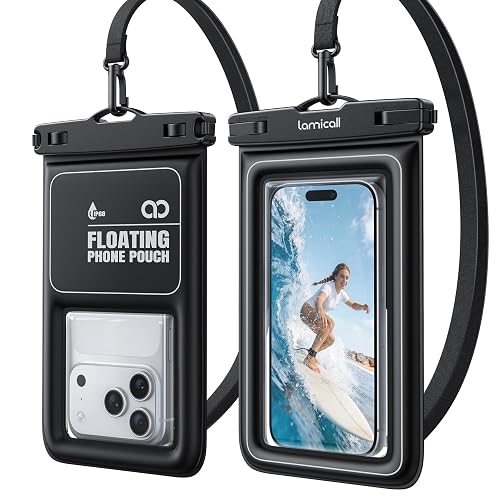

UNBREAKcable Floating Waterproof Phone Pouch, IPX8 Dry Bag for Kayak/Beach, 2 Pack
$21.99
Check price on Amazon →
PEDVSTY Large Waterproof Phone Pouch with Sealing Strip, Floating for Kayak
$11.19
Check price on Amazon →The floating strap: the accessory that saves your phone
It may sound like a minor detail, but it is what has saved the most phones on the lake. A floating strap is a foam band that attaches to your phone pouch or camera. If the device slips out of your hands —and with wet hands and a moving boat it happens more than you think— the strap keeps it on the surface instead of letting it sink.
It is an accessory that costs a few quetzales and prevents a loss worth thousands. If you are going to kayak or paddle board, or simply take photos from the side of the boat, do not head out without it. Combine the floating IPX8 pouch with the floating strap and you have double security.
Use on kayak, paddle board and swimming
Many travelers do not just cross the lake: they paddle it. San Marcos, San Juan and Santa Cruz rent kayaks and paddle boards, and there the dry bag stops being optional. On a kayak, the dry bag goes lashed to the deck bungee or between your legs; its buoyancy means that if you capsize, your things stay afloat beside you.
For swimming —whether from a dock or a platform— there are buoy-style dry bags (swim buoy) that you tow tied to your waist: they work as a visible safety float and a dry compartment at the same time. If your plan includes getting in the water, first check our guide to water shoes for swimming in the lake, because the shores have rock and slippery wooden docks. A dry bag plus water shoes is the basic kit for enjoying Atitlán without scares.
Final tips to stay dry on the boat
Before we wrap up, three tricks we learned crossing the lake: first, roll the mouth of the bag down at least three times before buckling, or the seal won't work. Second, if you travel in the afternoon, ask to sit at the back of the boat, where it splashes less than at the bow. And third, put your documents and cash inside a small zip bag inside the dry bag: a double barrier in case you open the main bag mid-trip. With the right gear, the Xocomil stops being a threat and the crossing becomes the best part of the day.
Frequently asked questions
What size dry bag do I need for a boat tour on Lake Atitlán?
For a full day visiting several villages, a 15 to 20 liter dry bag is the ideal size: it fits a change of clothes, a towel, a camera, snacks and a light jacket. For half a day or just the essentials (phone, documents, wallet), a 5 to 10 liter one is enough and gets in the way less inside the panga.
Does an IPX8 phone pouch really protect against lake water?
Yes. The IPX8 rating means the pouch withstands full immersion, not just splashes. For Atitlán, look for one with a touch window on both sides —to take photos and use the map without pulling the phone out— and that floats. Add a floating strap for double security if it slips out of your hands.
Does the same dry bag work for kayak and paddle board?
Yes. A roll-top dry bag floats and keeps everything dry both on the boat and on a kayak or paddle board. For kayaking, lash it to the deck bungee; for swimming, a buoy-style bag towed at your waist works as a safety float and a dry compartment at the same time.
Why does so much water splash in Atitlán's boats in the afternoon?
Because of the Xocomil wind, which blows from midday and kicks up waves half a meter high or more. The public boats go fast and jump over the waves, throwing water over the passengers, especially at the bow. That is why it is best to cross early and carry your gear inside a sealed dry bag.
This article contains affiliate links. As an Amazon Associate, we earn from qualifying purchases at no extra cost to you.