Best Waterproof Backpack for Boats and Rain on Lake Atitlán
20 July 2026 · Diego Monzón
Add us as a preferred source on Google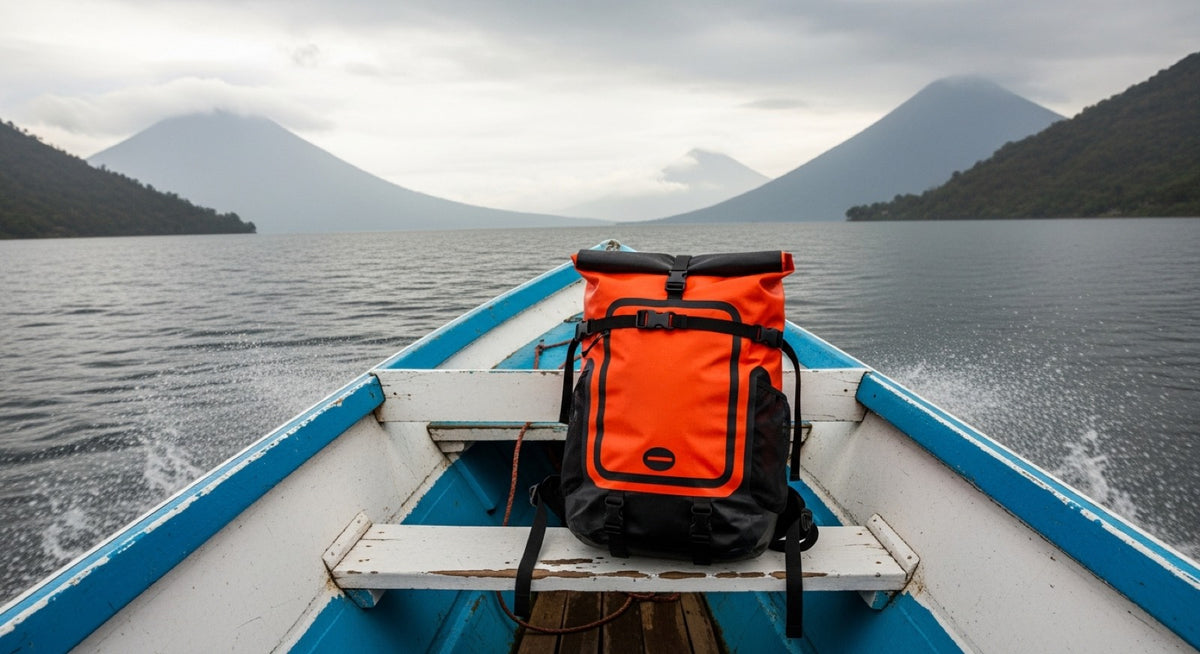
If you are heading to Lake Atitlán and plan to move between villages, there is one truth nobody tells you before you step aboard: you are going to get wet. The public boats are open vessels, they run full, and the water comes straight at you. As an Amazon Associate, I earn from qualifying purchases.
I live near the lake and have crossed from Panajachel to San Pedro dozens of times, in dry season and in pouring rain. I have watched phones die, passports warp and cameras fog up because someone trusted a "water-resistant" bag. That is why I put this guide together: five genuinely waterproof backpacks, with the reasoning explained, so you do not learn this lesson the expensive way.
How I picked these backpacks
The criteria were specific to Atitlán, not generic. First, a roll-top closure: it is the system that survives constant spray without relying on a zipper that clogs with dust from the dirt roads. Second, heat-sealed seams, not just stitched ones; that is the difference between truly waterproof and "water-resistant", which is marketing for "handles a three-minute drizzle". Third, buoyancy: if the pack goes overboard in a lake roughly 340 metres deep, you want it floating. And fourth, usable volume: 20 to 30 litres for day trips, 40 for moving with luggage.
Before buying anything, it helps to understand how to get around by boat between the villages, because the number of crossings you make each day determines the size you need. It is also worth reading about the Xocomil wind and the weather, the factor that decides whether your afternoon crossing is calm or a free shower.
Truly waterproof vs. water-resistant
This distinction saves you money and frustration. A water-resistant pack has treated fabric that beads off drops for a while; under sustained rain or a direct wave it saturates and leaks. A waterproof pack is built from non-porous laminated material — PVC or TPU over nylon — with heat-sealed seams and a closure that offers no entry points. The IPX ratings you see on electronics almost never apply to backpacks; here what matters is material, seams and closure. If the manufacturer does not mention sealed seams, assume it does not have them.
1. Bolsa seca impermeable 5L/10L/20L/30L/40L, mochila ligera

For anyone who wants one dry bag and is not sure what size they need: it comes in 5, 10, 20, 30 and 40 litres. It is the simplest and lightest option here, with a classic roll-top closure and a single compartment with no dividers. That is both virtue and flaw: it weighs almost nothing and packs down when empty, but everything you put in ends up jumbled at the bottom and you have to empty it to reach the lower layers. On the lake it works beautifully as a day bag for crossing from Panajachel to San Marcos with a towel, a sweater and a camera, or as a liner inside a bigger pack. The straps are basic and barely padded, so skip it if you plan to walk half an hour carrying 15 kilos from the dock to your guesthouse.
2. Mochila impermeable bolsa seca para viaje, hombre y mujer

This is the closest thing here to an actual backpack: a back panel with some structure, wider straps and outer pockets for the things you do not mind getting wet, like your water bottle or hat. It is what I would recommend to someone moving between villages with their luggage who does not want to juggle two bags. Note that the outer pockets are not waterproof: only the main roll-top compartment is sealed, so passports and phones go inside, not in the side mesh. It is slightly heavier than a pure dry bag, which you notice when you hoist it into a boat that has not quite stopped at the dock.
3. Waterproof Dry Bag Backpack 30L para kayak y lancha

Thirty litres is probably the most useful capacity for Lake Atitlán, and this model is built for exactly that: kayaking, boats and days on the water. It has a roll-top closure with a side buckle and a stiffer body that better resists rubbing against the wooden and metal edges of the public boats, which is precisely where cheap packs get scuffed and eventually leak. Its weak point is ventilation: the whole body is waterproof, so it does not breathe at all, and under midday sun at 1,562 metres of altitude your back will end up soaked in sweat. Most people happily accept that trade once they see their camera came out dry.
4. Piscifun Bolsa seca mochila flotante impermeable 10L/20L/30L/40L

Piscifun is a familiar name among anglers and kayakers, and this dry bag is their best seller for a reason: it does exactly what it promises without charging extra. It comes in 10, 20, 30 and 40 litres, floats properly when you seal it with air inside, and the material takes the daily abuse of getting in and out of boats. The straps are removable, so you can carry it as a shoulder bag on short hops or as a backpack for the steep stairs at the Santa Cruz dock. On the downside, the clear window on some versions scratches over time and stops being useful for spotting your gear.
5. MARCHWAY Mochila impermeable roll-top, bolsa seca flotante

MARCHWAY is worth considering if you want something proven and light that will not eat half your luggage. Roll-top, buoyant when properly closed, and with heat-sealed seams rather than merely stitched ones — the detail that separates a genuinely waterproof bag from a water-resistant one. It works just as well for a day on the San Marcos shore as for a September downpour on the walk from the boat to your hotel. The honest caveat: the material is thinner than on the stiffer options, so keep it away from sharp edges and do not drag it across the concrete dock. Treated well, it lasts for years.
Comparison table
| Backpack | Capacity | Closure | Best for |
|---|---|---|---|
| Lightweight multi-size dry bag | 5–40 L | Roll-top | Lightest; ideal as an inner liner |
| Waterproof travel backpack | Medium–large | Roll-top | Most backpack-like; external pockets |
| Dry Bag Backpack 30 L | 30 L | Roll-top | Stiff material; survives boat abrasion |
| Piscifun floating dry bag | 10–40 L | Roll-top | Removable straps; proven brand |
| MARCHWAY floating roll-top | Several | Roll-top | Heat-sealed seams; very light |
How to use it properly on the boat
Buying it is half the job; using it well is the other half. Roll the top down at least three times before clipping the buckle — two folds do not seal. Leave some air inside so it floats. Put the truly critical items — passport, cash, memory card — in a small dry bag inside the big one, because redundancy is cheap. Sit toward the back of the boat if you can; the bow takes the most water. And if you travel between May and October, assume afternoon rain every day even when the morning looks clear: lake weather sits between 15 and 25 °C and turns fast.
Frequently asked questions
Will I get wet on the Lake Atitlán boats?
Yes, almost always. The public boats linking Panajachel with San Pedro, San Marcos, San Juan, Santiago and Santa Cruz are open vessels that hit the swell head-on. Sit in the front rows or on the windward side and you will take constant spray; in the afternoon, with the Xocomil wind, the water comes in sheets. Add that between May and October a downpour can arrive at any moment. The practical rule is simple: anything you do not want soaked — camera, phone, passport, cash, laptop — has to travel inside something genuinely waterproof, not inside a normal backpack with a rain cover over it.
What capacity of waterproof backpack do I need?
It depends on whether you are doing a day trip or moving with all your luggage. For a day between villages — water, sunscreen, a sweater, camera, documents — 20 to 30 litres is plenty and the pack stays comfortable on the dock stairs. For relocating between villages or carrying several days of clothes, 40 litres is the sweet spot: it fits what you need without becoming impossible to lift into a moving boat. Remember that a dry bag loses usable volume when you roll the top: fill it to the brim and you cannot make the three folds that seal it, so buy one size up from what you think you need.
Roll-top or sealed zipper?
For the lake, roll-top. The rolling closure has no parts to fail: you fold the mouth over itself three or four times, clip the buckle, and the trapped air does the sealing. It is what kayakers use and what best withstands constant spray and rain. Sealed zippers of the TIZIP type are more convenient to open and close, but cost far more, get damaged by sand or road dust, and need periodic lubrication. For travel in Guatemala, where you will open and close the pack ten times a day with wet hands, roll-top is cheaper, simpler and much harder to ruin.
What is the Xocomil wind and how does it affect me?
The Xocomil is the local wind that rises almost every afternoon on Lake Atitlán, usually from midday and strongest between one and four. It comes down off the mountains, meets the warm air over the water and kicks up considerable swell on a lake around 340 metres deep sitting at roughly 1,562 metres of altitude. In practice that means two things: afternoon crossings are far rougher and wetter than morning ones, and boats sometimes cut frequency or wait it out. If you can, schedule long crossings early; if not, assume you will arrive soaked and keep your gear sealed.
Do waterproof backpacks float if they fall in the water?
Roll-top dry bags float as long as they are properly closed with air trapped inside and are not stuffed with heavy gear. That air is what keeps them up, so the trick is not to squeeze all the air out before rolling when you are on a boat. That said, do not treat them as life jackets: a pack loaded with a laptop, camera and water bottles will sink regardless. If you genuinely worry about losing something irreplaceable, put it in a small five or ten litre dry bag inside the big pack, and tie the pack to a seat or to your wrist during the crossing.
Conclusion
If you are only buying one, make it a 30-litre roll-top with sealed seams: it is the size that covers a day trip and still handles a short move between villages. If you travel with full luggage, go up to 40. And if you already have a backpack you love, a 20-litre dry bag inside it solves 90% of the problem for very little money. Lake Atitlán, with its three volcanoes and villages linked only by water, is far more enjoyable once you stop worrying about what you are carrying on your back.